A TOUR GUIDE IN ENGLAND: DAY 3 – PART THREE

Through the entrance gates of the Chelsea Physick Garden. 
From Wikipedia: The Chelsea Physic Garden was established as the Apothecaries’ Garden in London, England, in 1673. This physic garden is the second oldest botanical garden in Britain, after the University of Oxford Botanic Garden, which was founded in 1621.
The location was chosen as the proximity to the river created a warmer microclimate allowing the survival of many non-native plants – such as the largest outdoor fruiting olive tree in Britain – and more importantly, to allow plants to survive harsh British winters. The river was also important as a transport route that linked the garden to other open spaces such as Putney Heath, facilitating easy movements of both plants and botanists. In fact the garden has always sought to achieve good communications with others working in the same field: by the 1700’s it had initiated an international botanic garden seed exchange system, which continues to this day.
Dr. Hans Sloane, after whom the nearby locations of Sloane Square and Sloane Street were named, purchased the Manor of Chelsea from Charles Cheyne. This purchase of about 4 acres was leased to the Society of Apothecaries for £5 a year in perpetuity.
Environments for supporting different types of plants were built, including the pond rock garden, constructed from a variety of rock types, namely stones from the Tower of London, Icelandic lava (brought to the garden by Sir Joseph Banks in 1772 on a ship named St. Lawrence), fused bricks and flint. 
In 1876 the Garden enlarged its educational aspirations by deciding to run a lecture course for young women who were training as botany teachers. At the end of the 19th century the trustees of the City Parochial Foundation agreed to take over the running of the Garden from the Society of Apothecaries. In 1983 The Garden became a registered charity and open to the general public for the first time.
After a spot of lunch at the Gardens, we headed back to Sloane Square. 
The day had gone exactly as planned and we had glorious weather throughout. 
However, not all things go as planned, as evidenced when actor Nigel Havers walked 
past me in Sloane Square on his way into a florist shop. 
“That’s Nigel Havers!” I cried, grabbing Beth’s arm. 
“Where? Where’s Nigel Havers?”
“There! In the florists!”
“Are you sure it’s him?”

“It has to be. It looked just like him. Nigel Havers!”

“I’ll go and ask him if he is, shall I?”
I looked at her agog. “You’re going to speak to Nigel Havers?”
Instead of answering me, Beth strode purposefully towards the shop. Diane and I watched increduously as we heard Beth ask, “Excuse me, but are you Nigel Havers?”
“Only sometimes,” Nigel Havers responded. 
“It’s him! Quick, snap a picture!” I ordered Diane. I was incapable of doing much besides thinking `Nigel Havers!’
Nigel Havers! Chariots of Fire! Downton Abbey! Lots of other notable roles!
“My friend would love to meet you,” I heard Beth say to Nigel Havers. 
And before I knew it, Nigel Havers was standing beside me. 
We shook hands and I heard myself say, “I just watched you in the stately home documentary.”
“Oh, yes?” Nigel Havers responded, visibly confused. I couldn’t blame him, I was visibly confused. Why had I mentioned the documentary? I had just watched it, it was true, but of all the things to refer to in his entire body of work!
For God’s sake, why hadn’t I mentioned Coronation Street instead? His character Lewis had won Villain of the Year when he was on the show. I watch Corrie religiously. And I go and mention a country house documentary! Come back, Nigel Havers! Lewis! But Nigel Havers and his recently purchased flowers were already halfway down the sidewalk. 
“You met Nigel Havers!” Beth said brightly.
“Yes, and I never even mentioned Coronation Street.”
“But you were right, it was Nigel Havers!”
“And it was all down to you, Beth,” said Diane. “I can’t believe you had the nerve to ask him if he was Nigel Havers.”
Beth and Diane turned to me with bright smiles on their faces, “Nigel Havers!” they cried in unison. 
“Yes, Nigel bloody Havers. What an idiot I am. Lewis. Coronation Street. For God’s sake . . . . oooh, I just saw you in a stupid documentary, Lewis. I’m an idiot, I should have . . . . . . “
I can only conclude by saying that shortly afterwards I found myself in the Duke of Wellington pub, downing a much needed rum and coke, thanks to Diane steering me in the right direction. Honestly, I’m still not over the whole Nigel Havers thing . . . . .  
Part Four Coming Soon!

A TOUR GUIDE IN ENGLAND: DAY 3 – PART ONE

Diane and I began Day 3 with a cab ride to Sloane Square, where we met authors Louise Allen/Melanie Hilton and Beth Elliot for a visit to the Chelsea Physick Gardens. As some of you may know, Beth writes Regency romance and Louise writes Regencies, as well as several non-fiction books, including Walks Through Regency London and To The Field of Waterloo: The First Battlefield Tourists. I had mentioned to Melanie that I wanted to pop in to the Royal Chelsea Hospital in the hopes of visiting the site that once held Ranelagh Gardens, above. Melanie came prepared with research notes and a map and off we set – 
The four of us headed out of Sloane Square and down the King’s Road. 
It was fairly slow going, as we were chatting and stopping to take in 
architectural details along the way. 
Unfortunately, once we’d gotten to the Hospital, we discovered that the Ranelagh Gardens site was inaccessible, as the site was being prepared to host the Royal Chelsea Flower Show, opening in a few days time. Beth, Melanie and I decided instead to visit the Hospital’s Museum, while Diane was otherwise occupied, below. 
We found this portrait of the Duke of Wellington in the entrance hall, 
along with French Eagles, such as the one below. 
Back outside, we stopped for a photo before heading to the Physick Garden:
Left to right: Beth, Melanie and Diane. 
Part Two Coming Soon!

ONCE AGAIN WEDNESDAY: Prinny's Fete Honoring the Duke of Wellington

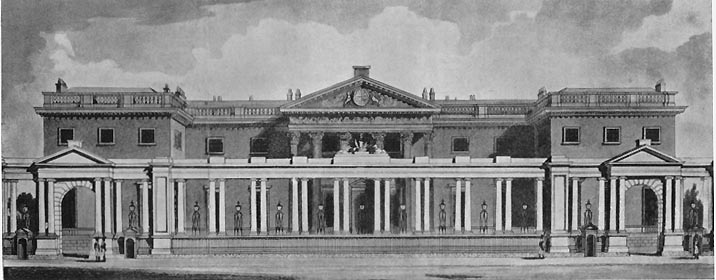
On July 21,1814 the Prince Regent held a Fete in the temporary rooms in the garden of Carlton House to honor the Duke of Wellington. The first of the two thousand guests began to arrive at nine o’clock. They were received at the grand entrance by equerries who conducted the guests to the fanciful rooms and tents on the garden front of Carlton House.

John Nash built a series of temporary rooms and buildings in the garden at Carlton House to house the fete. The illustration at right depicts the side garden in 1820. A polygonal ballroom one hundred and twenty feet in diameter with a tented roof was the main feature. The room was brick with a leaded roof. The interior of the ballroom was designed to give the impression of summer light, airiness, and festivity. It was designed to replicate a huge bell tent so the umbrella shaped ceiling was painted to resemble muslin. The upper walls and ceiling were then hung with gilt cords and tassels to further the resemblance to a tent. Muslin draperies covered the walls. They were swagged open to reveal mirrors hung on the walls. The ballroom was illuminated with twelve sparkling chandeliers. A pair of flower covered temples had been erected in the polygonal ballroom to screen the bands. A covered promenade hung with draperies and rose colored cords led to a Corinthian temple. Inside was a marble bust of the Duke of Wellington by Turnerelli placed on a column in front of a large mirror engraved with a star and a capital letter W. Another covered walkway hung with green calico displayed transparencies representing such subjects as the “Overthrow of Tyranny by the Allied Power”. Elsewhere in the garden were supper tents and refreshment rooms hung with white and rose curtains and with regimental colors printed on silk.

The Regent himself appeared in his field marshal’s full dress uniform wearing his English, French, and Prussian orders. He had long wished to be made a field marshal of the British army, but his father had steadfastly refused on the grounds that since George was the Prince of Wales and several of his brothers were pursuing military careers they should hold some honors he did not. Now, as Prince Regent, George could suit himself. The fete was a great success. Even the Queen stayed until half-past four and many guests were still there at dawn.

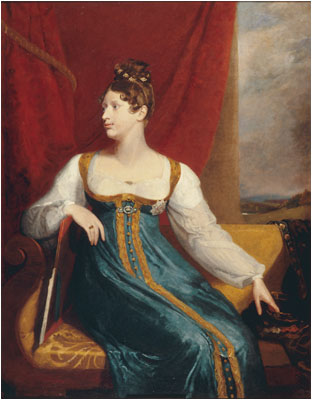
It’s interesting to note that only a few days before the fete, George IV had much more on his mind besides the upcoming festivities – Princess Charlotte and he had come to loggerheads regarding the question of where she was to live. The following account is from George IV: Memoirs of His Life and Reign by Hannibal Evans Lloyd, though this is just one of a hundred accounts of the episode:

The differences between the Prince Regent and the Princess of Wales caused his Royal Highness some pain on account of the Princess Charlotte, who on several occasions took part with her mother in opposition to his wishes. This led to some very remarkable transactions. Determined that she should be more immediately under his own eye, in the year 1814, on the 12th of July, the Prince Regent visited Warwick House, and informed the Princess Charlotte that he was come to dismiss all her household, and that she must immediately take up her residence in Carlton House, and from thence go to Cranbourn Lodge; and that five ladies, whom he named, amongst whom were the Countess Dowager of Rosslyn, and the Countess of Ilchester, were in the next room in readiness to wait upon her. After some expostulation on the part of the Princess Charlotte, the Prince remaining firm and resolute, she appeared to acquiesce in his determination; but pleading a wish to retire for a moment, to compose herself before she was introduced to the ladies, she was permitted to do so; and whilst the Prince was engaged in close conversation with Miss Knight, a lady of the Princess Charlotte’s household, she, in an agony of despair, privately left Warwick House, and throwing herself into a hackney coach, in Cockspur-street, drove to Connaught House, the residence of her mother. Here she found that the Princess of Wales was gone to Blackheath. She despatched a servant to meet her; and threw herself on a bed, exclaiming, “I would rather earn my bread, and live upon five shillings a-week, than live the life I do.” Before the Princess of Wales arrived, the Archbishop of Canterbury went to Connaught Place, to fetch the Princess Charlotte away; but Sicard, a faithful servant of the Princess, refused to admit him.

As soon as the discovery of the flight of the Princess Charlotte was made known to the Prince Regent, he sent for the ministers, and a council was held at the Foreign Office, and also at Carlton House. The Archbishop of Canterbury not succeeding in the object of his mission to Connaught House, the Duke of York was afterwards sent with a written message from the Prince, containing her father’s commands to bring her to Carlton House.

On the arrival of the Princess of Wales from Blackheath, she drove immediately to the Parliament House, and eagerly inquired for Mr. Whitbread, who was absent; she then inquired for Earl Grey, who was not in town; and, disappointed, she hastened to her own house in Connaught-place, and had an affecting interview with her daughter, with whom she continued till three o’clock in the morning. Soon after this time the Princess Charlotte was conveyed, by the Duke of York, to Carlton House; having been previously informed by Mr. Brougham (who had been sent for by the Princess of Wales), that by the laws of the land, she must obey her father’s commands. Period.

So, aside from that, Princess Charlotte, how’d you enjoy the fete?

Originally published 7/21/10

A TOUR GUIDE IN ENGLAND: DAY 2 – PART 3

After our visit to the National Portrait Gallery, Diane and I once more decided to wander aimlessly through our favourite City. We soon came across Godwin’s Court, above, located off of St. Martin’s Lane. Built around 1630, it was originally called Fisher’s Alley and lately, it stood in as Knockturn Alley in the Harry Potter films. Coincidentally, Cecil Court, where Diane and I visited Mark Sullivan Antiques earlier in the day, stood in for Daigon Alley in the films, as well. 
But Godwin’s Court is not a film set, it exists as you see it above day in and day out, which is what I love about London. There are pockets of centuries old history to be found almost around every corner, if one knows where to look. See the sign below.
Above is Seven Dials, once one of the worst areas of London and a true rookery and one that Dickens was familiar with. Seven streets intersect here, warehouses abounded and many of the taverns had interconnecting basements through which thieves and ne’er do wells could escape the clutches of the law, such as it was in the 18th and early 19th centuries. 
Above and below, further peeks into the City’s 18th century past. 
After a while, we found ourselves in Charing Cross Road and in the same block as the few remaining antiquarian and second hand bookshops that survive here. When writing blog posts, I often forget that  people I do not know, people who are younger than myself and people who haven’t been to London may be reading my posts. I assume that others know as much about the things I write about as I do, and so I often forget to include bits of history or back stories to the places I feature. I do not want to do that here. This I must tell you – if you haven’t read a book called 84 Charing Cross Road, you must rectify that immediately. Set just after WWII, the book covers the relationship in letters between a bookseller in London and a customer in New York who places requests for books via mail. There is also a movie of the same title starring Anthony Hopkins and Ann Bancroft which you are perfectly free to watch, but I urge you to read the book first and see the film afterwards, rather than watching it  instead of reading the book. 
After a good browse, during which I found but a single title and that for my mate Ian Fletcher, rather than for myself, we continued our stroll. 
The entrance to The Ivy restaurant above and the stage door of the St. Martins Theatre, below. 
Neither of us having seen The Mousetrap before, Diane and I decided to take in a performance and it was a hoot – a murder mystery set in an isolated English country house sometime in the 1940’s, Agatha Christie’s Mousetrap is the longest running play in history. Afterwards, we returned to our hotel for dinner and indulged in ribeye steaks, chips and pinot noir. 
The perfect end to a truly perfect day. 
Day Three Coming Soon!