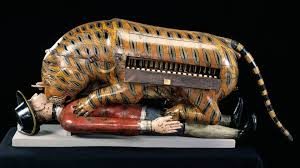
On a recent visit to London, I visited the Victoria and Albert Museum with my friend and travel companion, Denise Costello. In particular, we wanted to see “Tippoo’s Tiger,” made for Tipu Sultan, ruler of Mysore in South India (1782-1799) and later captured by Wellington’s army.
From the V&A:
The almost life-size wooden semi-automaton consists of a tiger mauling a prostrate figure in European clothes. An organ is concealed inside the tiger’s body, and when a handle at the side is turned, the organ can be played and the man’s arm simultaneously lifts up and down. Intermittent noises are supposed to imitate the wails of the dying man.
The tiger was discovered by the British in the palace at Tipu Sultan’s capital after the Siege of Seringapatam in 1799. The invading army stormed through a breach in the ramparts and, in the ensuing chaos, Tipu and a great many of his soldiers, generals and the citizens of the town were killed. The victorious troops then rampaged through the city, looting valuables from the palace and from private houses, until Colonel Arthur Wellesley (later the Duke of Wellington) gave an order for hanging and flogging which quickly restored order. The contents of the royal treasury were then valued and divided between the British army over the next weeks according to the conventional practice of the period. Some time later, the tiger was discovered in the music room of the palace and was shipped to London, where it arrived in 1800. It was sent to East India House, the headquarters of the East India Company which housed a library and new museum, and soon became one of the most popular exhibits. The Indian Museum, as it became known, moved several times before parts of the collection, including Tipu’s tiger, were transferred to the South Kensington Museum, later renamed the Victoria and Albert Museum.
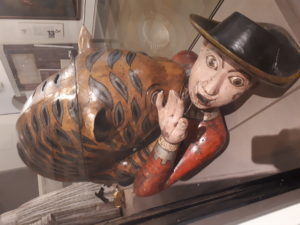
Of course, once we’d seen the Tiger, Denise and I visited the other galleries and these are just a few of the items in the items I found of particular interest –
From the V&A:
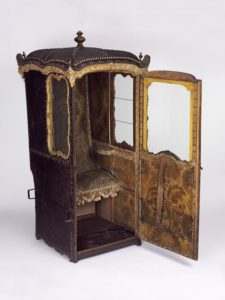
The sedan chair was a popular form of non-wheeled transport in Europe until the 19th century. It was fitted with a seat for one person, and was carried by two or four chairmen (depending on the occupant’s weight), who lifted it using two long poles that slotted into brackets on the side of the chair, attached to leather straps that hung round the chairmen’s necks. Sedans were particularly useful for travelling through cities with narrow streets. This sedan chair was probably made in Piedmont / Savoy in Italy. Several similar chairs of about the same date survive in Italy, France and the UK, including one at Westminster Abbey which was bought in Rome in the early 19th century.
The exterior of the sedan chair is covered with black leather. There are three windows, one in the door and one on either side. Brass round-headed studs are arranged in decorative patterns around the windows and follow the outline of each side of the chair, at the same time forming a girdle round the chair about half way up . . . . The front window is made to drop downwards, into the body of the door on a strap punched with several holes that can be hooked onto a tack attached to the inside of the chair door just below the window.The window strap is stamped and gilded and may be an early 19th century replacement. The side windows slide back, and the glass in these two windows is protected by two thin metal horizontal wires (possibly 19th century). The door itself is designed to be completely removeable and can simply be lifted off its hinges.
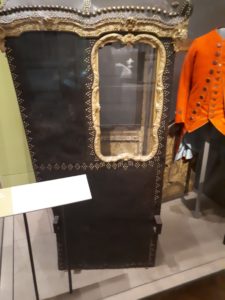
At each side of the chair near the base are two iron brackets (known as pole lugs), back and front, to accommodate carrying poles (the poles are modern). The rear two of these may not be original. The roof, the shape of a shallow umbrella, has eight radiating struts, which are also decorated with brass studs arranged in rosettes. The four corners of the roof are upturned into a scroll formed of laminated leather, the back right-hand one of which is bent over. Immediately below them are carved wooden female masks, painted. Behind each corner scroll, on the roof, is a brass finial, triangular in section. The central finial is a replacement, of carved wood, made by the Museum in 1968. The whole roof is surrounded by large brass studs, and below is a carved wooden cornice, with gadrooning and scrollwork. On three of the four sides of the chair, just below the roof, is a small iron loop: originally large tassels would have hung from these, but they do not survive.
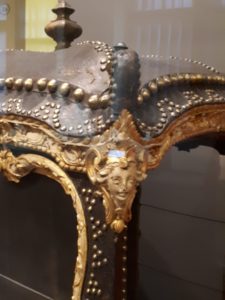
The interior is, except for the floor, lined with pale olive green (perhaps once saffron yellow) stamped woollen velvet on a linen warp, with a floral design with a very large repeat. The seat has 22 inch width, the standard width for a handloom. There are two small padded arm rests. These and the base of the padded seat, below the windows, and at the base of the roof are trimmed with pale olive-green fringing, of cord with floss tassels, and braiding 1.6 inches wide, in linen woven with a diamond pattern. Originally there would have been a valance hanging from the seat down to the floor, hiding the area under the seat which was often used for storage or for a heater. The stuffing of the seat is probably horsehair. Under the seat the walls appear to be relined at the back and sides.The velvet on the underside of the roof is held in place by nailed tapes and the pattern is not symmetrically placed. The wooden floor has a leather mat, nailed in position with brass-headed nails in a decorative pattern of symmetrical scrolls. This is much worn and the leather outer covering of the sedan chair is torn in places on the door.
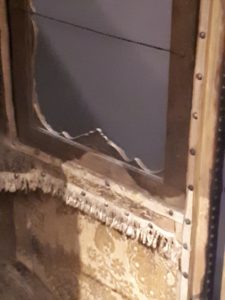
Externally, the back of the chair curves inwards at the base to allow space for the rear carrier to walk. This shape is characteristic of sedan chairs made in Piedmont / Savoy. The carved decoration and shape of the roof is reminiscent of French carriages dating from the early 18th century. The style of the carving seems to be that of the 1720s, but is of a style that continued to be used for the decoration of sedan chairs for several decades.
From the V&A:
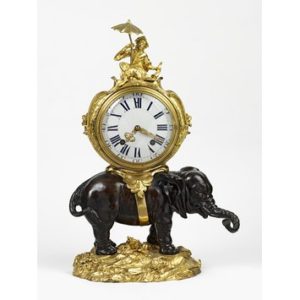
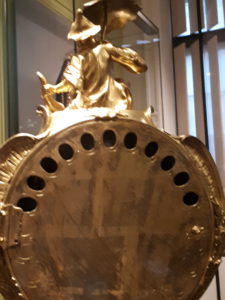
Elephant table clock, the case and movement signed by different craftsmen. The case proclaims it was ‘made by Caffieri’, while the movement is signed by Jerome Martinot (1671-1724), the enamelled dial has been signed on the back by Antoine-Nicola Martinière and a spring in the movement has the signature of ‘Magny’ (perhaps Alexis Magny). The number of signatures reflects how such clocks were assembled by ‘marchands merciers’ (or ‘luxury goods merchants’) in Paris who commissioned works of art which combined contrasting luxury materials including bronze, horn, porcelain and ormolu. Such elaborate clocks often included an organ in the base, although this does not survive for the V&A example. Other mid-eighteenth-century clocks incorporate elephants in ormolu (gilded bronze) or Meissen porcelain, or lions in Chinese porcelain. Only three clocks cast entirely in bronze like this one have survived, and it has been argued that the V&A clock is the earliest example. Although the surface chasing on the V&A’s example is not of the highest quality, this may be explained by the later regilding which covers the original chased surface. When it entered the Museum in 1882, the clock stood on a later ebony base with gilded bronze mounts and the dial, despite Martinière’s eighteenth-century signature, may well have been re-enamelled in the nineteenth century.
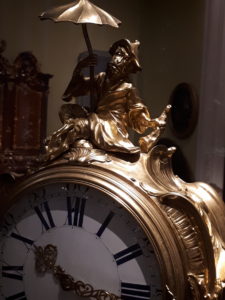
The drum of chased gilded bronze, scroll design, surmounted by the seated figure of a draped monkey holding up a parasol with his right hand and a horn in his left; the drum rests on the back of a bronze elephant standing on a base of gilded bronze rockwork. The quality of the chasing is very high; the central plant on the base has been cast as a separate feature. The slightly reddish patina of the elephant is characteristic of 18th century work. A rectangular ebony stand with gilded bronze mounts that accompanied the clock when it entered the collection is probably a later additon.
From the V&A:
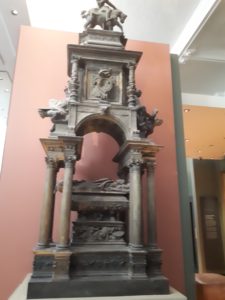
After the death of the 1st Duke of Wellington in 1852, the government announced that a competition was to be held for the design for a monument to commemorate him. This was Alfred Stevens’s competitive sketch model, and was among those exhibited at Westminster Hall, London, in 1857. one of the most important sculptors in Britain in the 19th century, and executed a wide variety of work, including designs for silver and maiolica, firedogs and chimney-pieces, as well as sculpture. Although Stevens’s model came fifth in the competition, which was won by William Calder Marshall (1813-1894), it was actually judged more suitable to the monument’s setting, which was to be St Paul’s Cathedral, and he was therefore awarded the commission. The monument, which was not unveiled until 1912, 37 years after the artist’s death, was completed by his pupil Hugh Stannus (1840-1908). Stevens had made some changes to the design, and the finished monument therefore differs in some respects from this model, but the general composition remained. The model is made from plaster and wax, with metal armatures; in form it echoes Italian Renaissance monuments.
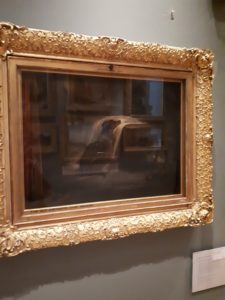
Imagine my surprise when I turned a corner to find this, my favourite painting, Landseer’s “The Old Shepard’s Chief Mourner.”
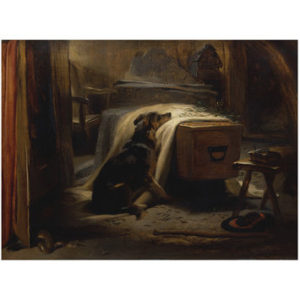
From the V&A website: Artist Edwwin Landseer’s choice of subject illustrates the Victorian obsession with the trappings of death, combined here with his speciality, the accurate and almost anthropomorphic representation of dogs and other animals. Its mixture of pathos and realism appealed to all sections of society, and the critic Ruskin praised the fine technique and the subtle choice of details. This painting was exhibited at the Royal Academy in 1837 and proved a great success, particularly as an engraving after this picture was published and sold widely in the following year.
Edwin Henry Landseer (1802-1873) was a child prodigy, exhibiting some drawings at the Royal Academy when he was only 13. From an early age he was a frequent visitor to the menagerie in Exeter Change in the Strand, London, where he drew lions, monkeys and other animals. Animals remained the main subjects of his art. Queen Victoria collected his paintings, as did John Sheepshanks. The two biggest collections of his work are in the Royal Collection and here in the Victoria and Albert Museum.