Dr. Syntax, Part One

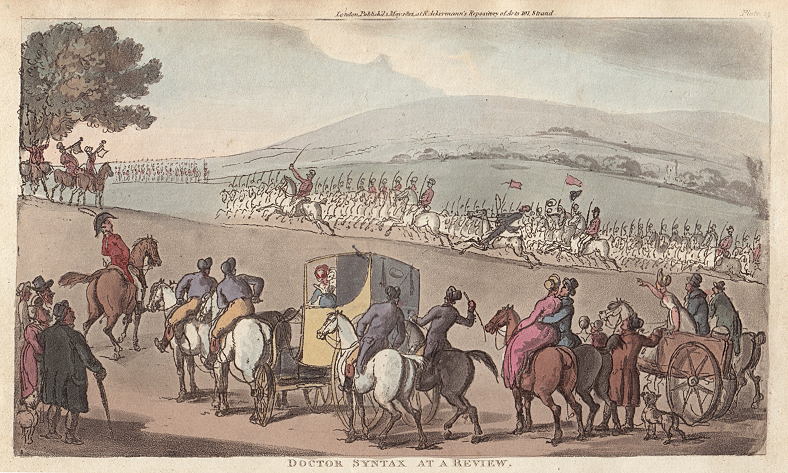
Dr. Syntax at a Review, 1812  Thomas Rowlandson, artist

My introduction to The Tour of Dr. Syntax in Search of the Picturesque  came from this old hand-colored etching.  Though I don’t remember when or where I found it, it must have been in a bin of prints at a London dealer — one of several I like to visit when in Town. Something appealed to me and I bought it, brought it home and framed it.  I look at it everyday in my office.

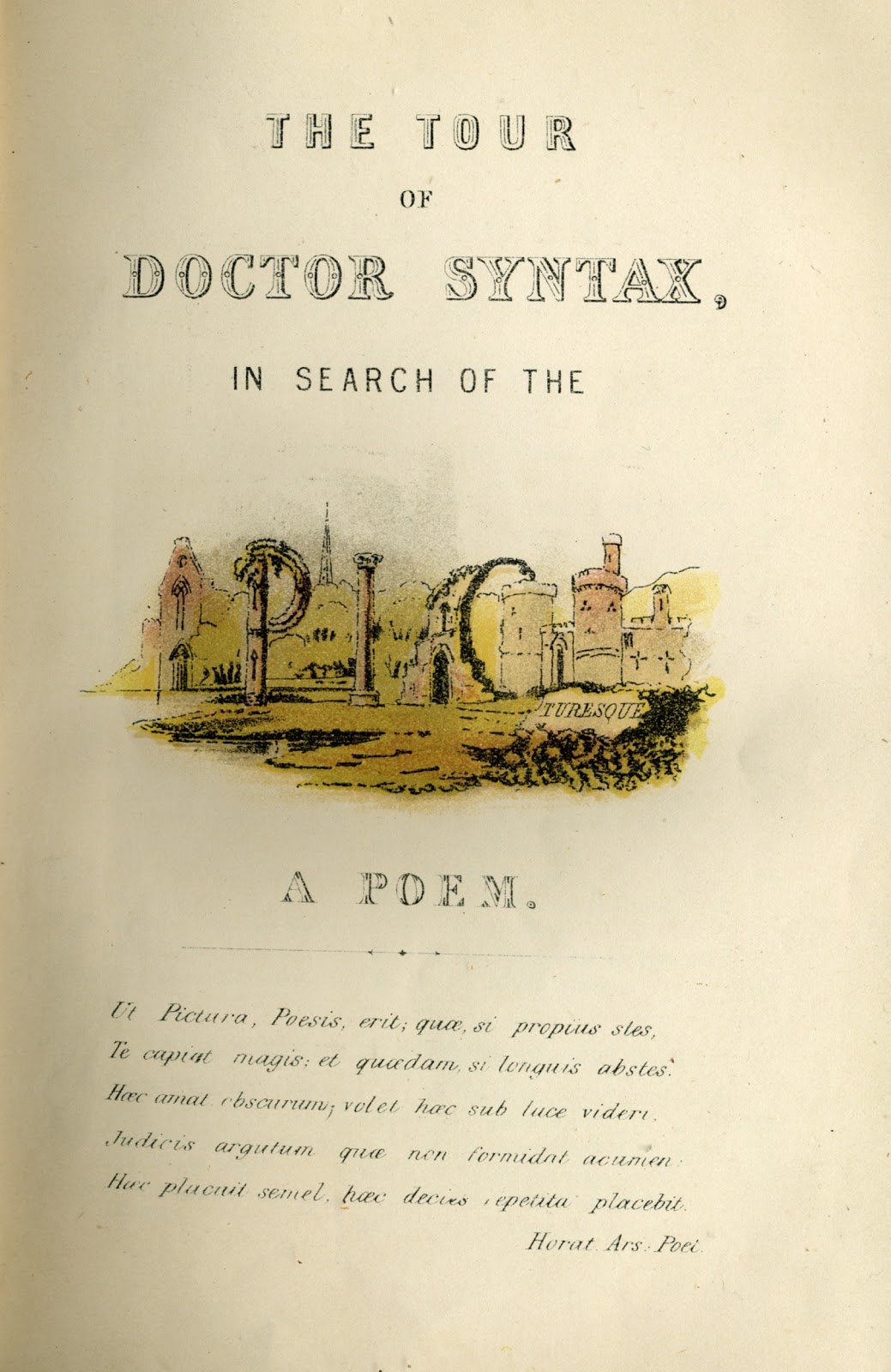
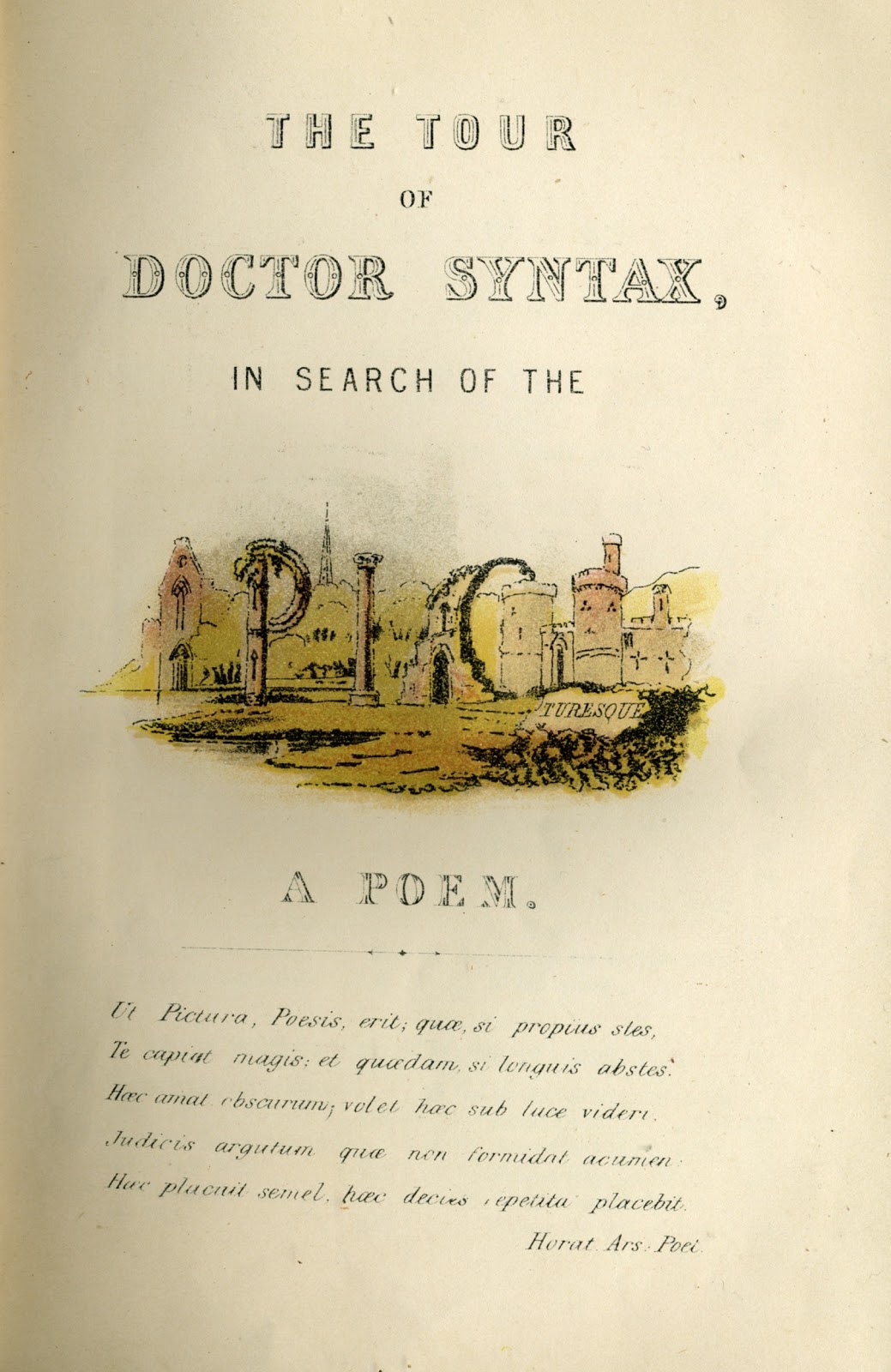
Title page, 1812
Note the way the word Picturesque is written into a drawing — something that our friends at Google seem to do more and more with the title of their search page.  My first post on the Picturesque (October 24, 2012) was concerned with my attempt to understand the precise nature of the term “picturesque” as used in the title. As delineated by the writer and traveler William Gilpin in the late 18th century, it referred to a landscape with handsome irregularities such as twisted tree limbs, craggy mountains and so forth.
Dr. Syntax and his three series of adventures were meant to be something of a satire on Gilpin. his travel books, and his theory of picturesque.  Written in rhyme, the Syntax stories tell of a ne-er do well parson and schoolteacher who tries to make his fortune by imitating Gilpin, traveling, sketching and publishing books. Here are the opening lines of the first book, published in 1812.
The School was done, the business o’er,
When Tired of Greek and Latin lore,
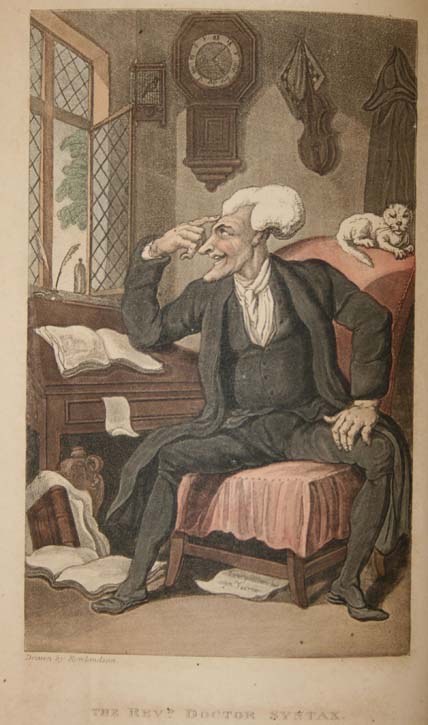
Good Syntax sought his easy chair,
And sat in calm composure there.
His wife was to a neighbor gone,
To hear the chit-chat of the town;
And left him the unfrequent power
Of brooding through a quiet hour.
Dr, Syntax, frontispiece, Rowlandson, 1812

For a number of lines, the good Dr. S thinks about his situation, various unlikely prospects, and of his need for income.


This if the times refused to mend,

He to his school must put an end. How hard his lot! How blind his fate!
What shall he do to mend his state?
Thus did poor Syntax ruminate.
After considerable cogitation (and many rhyming lines), his wife returns.  She is not sympathetically described:
Good Mrs. Syntax was a lady
Ten years, perhaps, beyond her heyday;
But through the blooming charms had flown
That graced her youth; it still was known
The love of power she never lost,
As Syntax found it to his cost:
After a discussion in which both husband and wife decry their poverty, Dr. Syntax makes his proposal to earn a fortune.  His reference to Dr. Pompous is a barely disguised reference to Gilpin.


“I’ll make a tour—and then I’ll write it.

You well know what my pen can do,
And I’ll employ my pencil too:–
I’ll ride and write, and sketch and print,
And thus create a real mint;
I’ll prose it here, I’ll verse it there,
And picturesque it everywhere.
I’ll do what all have done before;
I think I shall—and somewhat more.
At Doctor Pompous give a look
He made his fortune by a book:
And if my volume does not beat it,
When I return, I’ll fry and eat it.

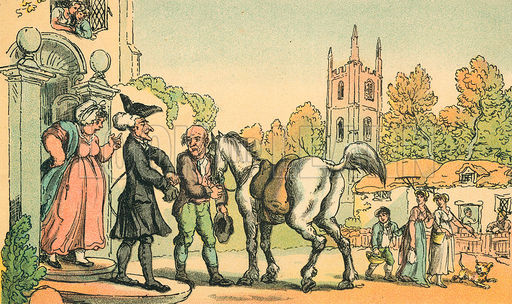
Dr. Syntax Setting out on his Tour to the Lakes, Rowlandson, 1812

Mrs. Syntax eagerly enters into his preparations for his tour and in a few weeks he is ready to depart.  Ralph is his stableman, and Grizzle is his horse (the gray palfrey, later an important character in the story).   

At length the lingering moment came

That gave the dawn of wealth and fame.
Incurious Ralph, exact at four,
Led Grizzle, saddled, to the door;
And soon, with more than common state,
The Doctor stood before the gate;
Behind him was his faithful wife;–
“One more embrace, my dearest life!”
Then his gray palfrey he bestrode,
And gave a nod, and off he rode.
“Good luck! Good luck!” she loudly cried,
“Vale! O Vale!” he replied.

Thus ends Canto One. We will continue with more of the poem in weeks to come.

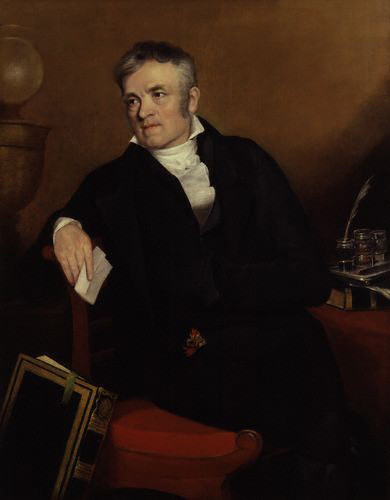
Dr. Syntax was produced by the famous Rudolph Ac
kermann (1764-1834), who published a number of periodicals, including his famous Repository of the Arts, Literature, Commerce, Manufactures, Fashion and Politics from 1809 to 1828.

Rudolph Ackermann, 1814, by Francois Mouchet, NAG, London

The pictures were by artist Thomas Rowlandson and the copy was written by a fascinating character, William Combe, who had an intriguing career  We will bring you more about them in the next installment.

Gilpin and the Picturesque

Victoria here.  Today, I want to explore — or at least skim over — the concept of the Picturesque — as a sort of introduction to bringing a few scenes from The Tour of Dr. Syntax to this blog. 

I am sure that like me, you have your own personal idea of what “picturesque” means. My ideas were formed before learning of the particular theories of Rev. William Gilpin in the 18th Century.  Before consulting the dictionary, I found this picture of a quaint cottage which I would call picturesque. In fact, in my mind,  I guess picturesque is almost a synonym for quaint. Or pretty, charming, old fashioned, etc.

Duck Island Cottage, St. James Park, London

But this is not what Gilpin and meant by “Picturesque.”  His theory was more sweeping (pretentious???).

Many 18th century theorists wrote on aesthetics.  They differentiated among definitions of “beauty” (instinctively attractive and pleasing) and “sublime” (inspiring awe, perhaps even fear or terror).  They argued among themselves about nuances of various meanings.

With the benefit of hindsight, we can identify signposts on Western culture’s journey from the Age of Enlightenment to the Age of Romanticism, from the emphasis on classical ideals to nature’s sometime-chaos.  This aesthetic debate was part of it, from the balanced proportions of classicism to the wild torrents of the romantic in art.

Here are two examples of what I mean, not necessarily what ANYONE else means.

Jacques-Louis David, Oath of the Horatii,  1784 The Louvre, Paris
Example of (neo)classicism

J.M.W. Turner, Tintern Abbey, 1794, Tate Britain
Example of Romanticism

The extremes of the two styles are perhaps even more evident in architecture.

Chiswick House, Greater London, English Heritage, finished  1729
Lord Burlington and William Kent, architects in the Palladian neoclassical style
Strawberry Hill House, Great London, redone from 1749-1776
Horace Walpole and friends, architects, in the neo-Gothic style
On that great aesthetic journey from the Age of Classicism/Reason to Romanticism, one of the movers and shakers was William Gilpin, who lived from 1724 to 1804.  Gilpin was a clergyman, travel writer and observer who developed ideas about what was worthy of a picture — that is, by his definition, picturesque — in the English countryside.
William Gilpin by artist Henry Walton, 1791, NPG, London

At Queen’s College, Oxford, before being ordained as an Anglican clergyman, Gilpin wrote of landscape and what he believed made a scene picturesque, that is worthy of sketching or painting.  He liked wild scenes, craggy mountains, twisted trees, a general sense of unquiet in nature. In the last quarter of the 18th century, his travel writings and the engravings of his nephew became widely read and studied.  These trips were taken in the intervals between his terms as headmaster of a school for boys.

William Gilpin, Landscape with a Ruined Castle, 1790, watercolor

.
Gilpin’s work was very influential among aesthetic theoreticians and artists.  Perhaps one of his most famous “pupils” was the landscape designer Humpry Repton, who often “improved” on Capability Brown’s classical English landscape to include a grotto or a hermitage, for example.

Gilpin’s writings and drawings were well known to Jane Austen, who referred to his views in several of her novels, sometimes in a rather satirical vein.  For an excellent discussion of JA and WG, see the excellent blog AustenOnly here.

William Gilpin, Scaleby Castle, Cumbria
All of this discussion is by way of introduction to a few posts I will be doing here in the next weeks, dealing with The Tour of Dr. Syntax in search of the Picturesque by William Combe (1741-1823), another writer who took a satirical view of Gilpin and other travel writers of his time.

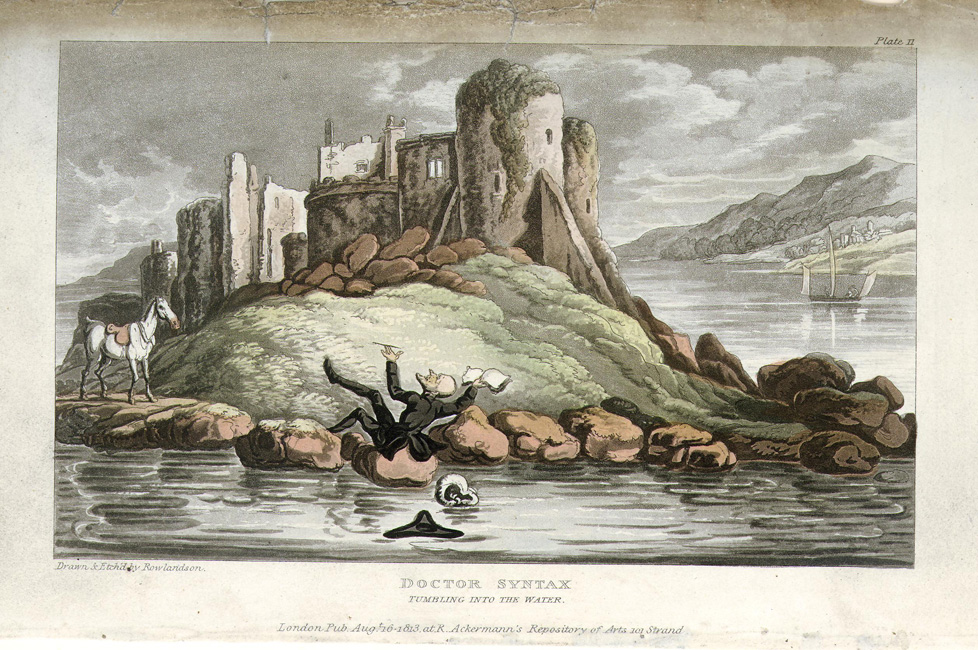
The contrast in approach can be easily seen in the two pictures above (perhaps enlarged for clearer viewing), with Dr. Syntax falling backward into the river in front of the castle, in one of the many illustrations for the series done by artist Thomas Rowlandson.

I hope you enjoy the excerpts I choose from Combe’s lines and the wonderful illustrations by Rowlandson, to start soon.
A Couple In England – In Search of a Happy Medium

As you can imagine, with less than two months to go until our sojourn to England, I have been meticulously planning each and every day of our vist to London, Bath and Winsdor. Okay, I’ve been micro-planning every day. Which isn’t easy, as there’s so much to do and so little time, not to mention the fact that I’ve got to devise an itinerary that will strike just the right balance between keeping Hubby entertained and simply exhausting him. As it is, he’s dreading being with me in London again, when I go into “London mode.” That is, with so little time at my disposal, I get up at dawn, walk at warp speed, go all day long and fall glassy eyed into bed each night.
Recently, I let Hubby in on what I’ve planned for us in London – so far: Kensington Palace, the Vault at the Hard Rock Cafe (for rock loving Hubby), the Changing of the Guard, the Guards Museum, Fortnum and Mason, Liberty’s, Winter Wonderland in Hyde Park (including tickets to the circus and observation wheel), theatre tickets (One Man, Two Guvnors), a three hour chauffeured Beatles and rock tour of London (for Hubby), Apsley House, a visit to my favourite antique dealer, a bit of shopping, dinner at the Duke of Wellington pub, a stop at Boots in order stock up on make-up and toiletries, a bookstore or two, etc. etc. etc. I finished telling him about our itinerary with the question, “Do you want to go to the Hollywood movie costume exhibit at the Victoria and Albert Museum?” To which he responded, a tad touchily (IMHO)”Do you?”
“You know,” he continued, “we don’t have to do something every single minute of every single day.” I think I mentioned in a previous post what a comedian the man can be. “Aren’t we going to have any time to just relax in the hotel room?”
“You want me to go to London and spend time in the room?”
“Do you have something planned for us every night, too?
“Well . . . yes, but some nights will be earlier than others.”
“”They may be earlier than you think. Especially for me. I need my rest. I’m old.”
“You’re not that old. Not old enough to go to London and spend all your time in the hotel room.” I would have quoted Dr. Johnson’s famous “tired of London, tired of Life” line to him if I’d thought it would do any good, but managed to refrain.
Honestly, he should only know what I’ve left off the agenda – a moonlit stroll along the Embankment, ice skating at Somerset House, research at the British Library, an hour or so smelling candles at Jo Malone, Portobello Road, Maggs Brothers, etc. etc. etc. The sacrifices I make . . . . I can hardly wait until I break the news to him about our Bath itinerary. Hopefully Hubby won’t notice that I’ve only scheduled seven hours between our ringing in the New Year and visiting Longleat House. Sleeping is so overrated . . . . .

Treasures of Kenwood Exhibition Opens in Milwaukee

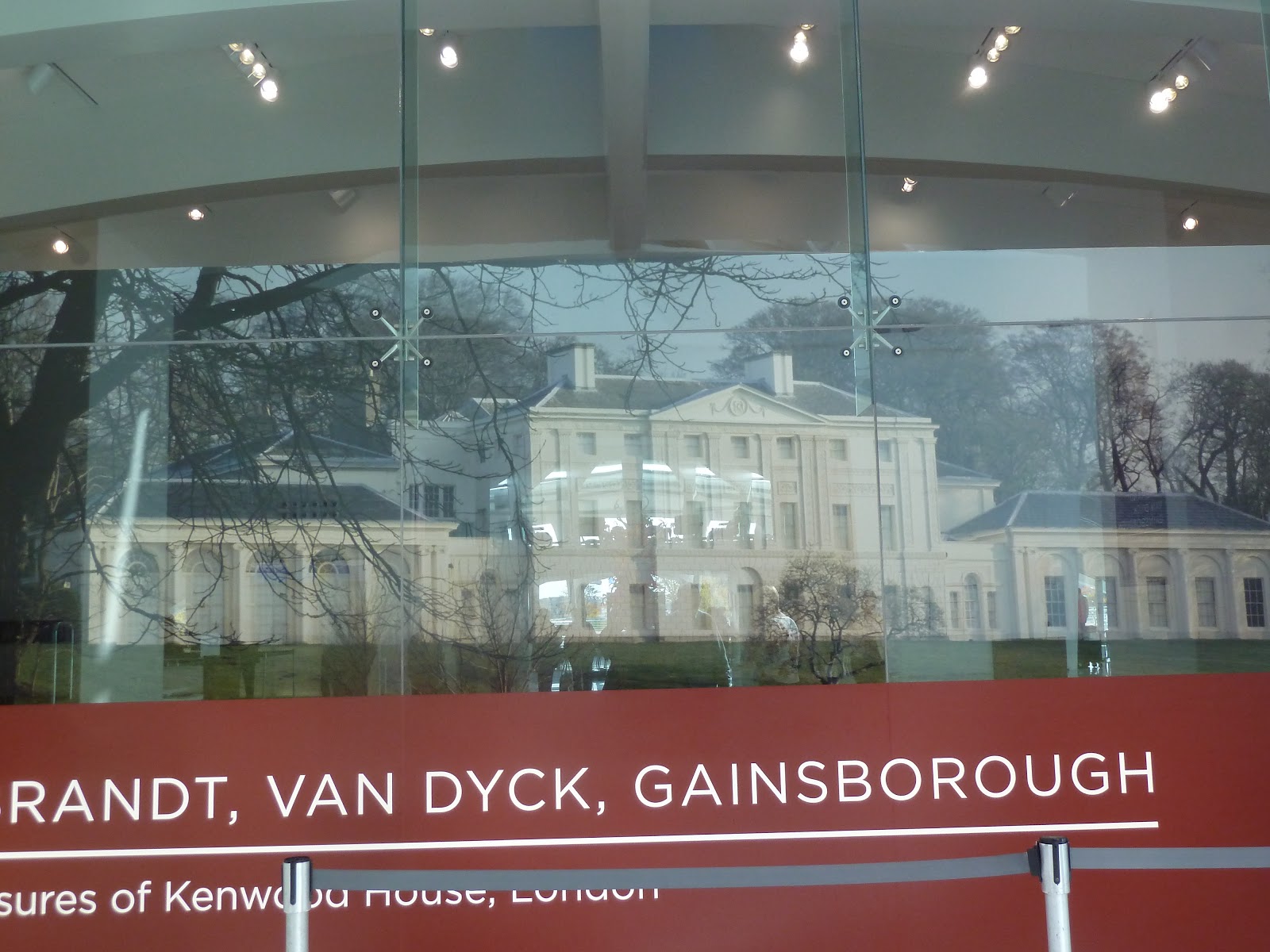
Victoria here. I have been eagerly awaiting this exhibition of great paintings from London’s Kenwood House.  While the magnificent mansion near Hampstead Heath is being refurbished, a selection of the finest paintings from the Iveagh Bequest, usually on display there, are traveling around the U.S.  First stop was Houston, and now it is in my front yard until January 13, 2013.  Hurrah!!

Kenwood House, The Iveagh Bequest, 18th C.

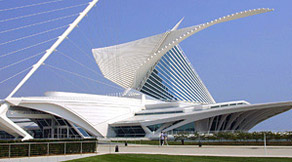
The Milwaukee Art Museum has a home equally stunning to Kenwood, if diametrically opposed in style. 

Milwaukee Art Museum, 21st C.

The MAM mounted the paintings in a stunning series of  rooms, the walls colored to enhance enjoyment of the works, from delicate blues to vivid crimson.  Accompanied by  excellent text panels, brochures, audio guides, and catalogues, the exhibition will also feature lectures, gallery talks and book signings.  The full schedule can be found here.  I wrote about the traveling exhibition and Kenwood House on this blog in August, and you can read it here.

Entering the exhibition preview day, along with hundreds of other eager members, I had to put away my camera since no photos were allowed within.  You will see many of the paintings below, from more official sources, until I make my very predictable way to the Gift Shop.

Rembrandt van Rijn, Portrait of the Artist, ca. 1665

Undoubtedly the premier painting to most viewers is this moving self-portrait Rembrandt painted about 1665 at age 60.  Other outstanding paintings from the low countries include portraits by Franz Hals, Anthony Van Dyke, and Ferdinand Bol, and landscapes by Cuyp and others

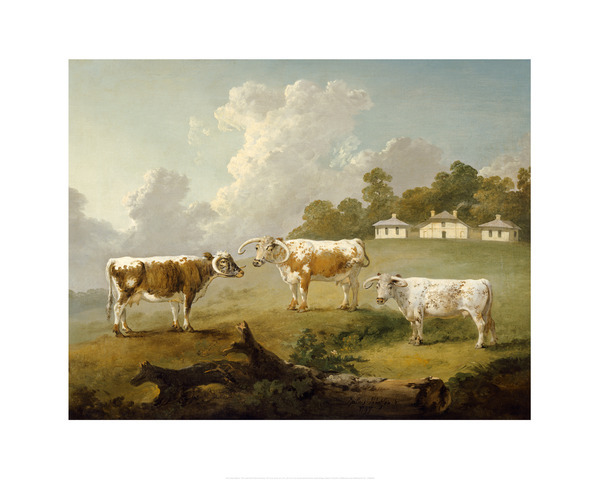
Julius Caesar Ibbetson, Three Long-Horned Cattle at Kenwood, 1797
English Heritage Purchase, 1999
The painting above was acquired for the collection fairly recently because it shows the Dairy standing in Kenwood’s park, though the three cows are quite detailed and worthwhile in their own regard, I guess. After the current restoration at Kenwood, the Dairy will be open to visitors.
Anthony Van Dyke, James Stuart, 1st Duke of Richmond and 4th Duker of Lennox, ca.1636
Iveagh Bequest
Van Dyke, who was born in  Antwerp, painted many English courtiers and the royal family during the reign of Charles I. His baroque techniques of portraiture inspired many artists. You will not be surprised to know that my favorite pictures, the ones I lingered over the longest were the English portraits, by all of the leading lights of the late 18th and early 19th centuries.
Mrs. Sophia Musters (1758-1819), a popular society beauty, is painted below by Reynolds as Hebe on Mount Olympus, pouring nectar for a magnificent eagle, who represents the god Zeus. The catalogue refers to this painting as the “ultimate male fantasy.”


Joshua Reynolds, Mrs. Musters as “Hebe,” 1782
Iveagh Bequest

 I remember attending an exhibition at the Tate Britain a few years ago, Joshua Reynolds: The Creation of Celebrity, in which the following portrait of Kitty Fisher, a courtesan, as Cleopatra, was shown. Reynolds painted many women who were actresses and/or courtesans, adding to their celebrity.

Reynolds, Kitty Fisher as “Cleopatra” Dissolving the Pearl, 1759
Perhaps the most famous of the actresses who were also mistresses of prominent men was Dora Jordan (1761-1849), who was very popular on the stage, particularly in comedic roles.  For many years, she lived with the younger brother of the Prince Regent, the Duke of Clarence (1765-1837).  Dora bore him ten children, but in the aftermath of the death of Princess Charlotte, only child of the Prince Regent, the Duke of Clarence had to marry and an actress would never do as the potential queen. 
John Hoppner, Mrs. Jordan as “Viola” in “Twelfth Night,” ca. 1785-92
Iveagh Bequest
 Long before  he became King William IV, the Duke had abandoned Dora, who died in poverty.  But King William did take care of his illegitimate offspring, making the eldest boy an earl and overseeing good marriages for the others.  He and his wife, Adelaide of Saxe-Meiningen (1792-1859), had several children who died at birth or shortly thereafter.  The ultimate successor was Princess Victoria, daughter of Prince Edward, Duke of Kent, an even younger brother of George and William.

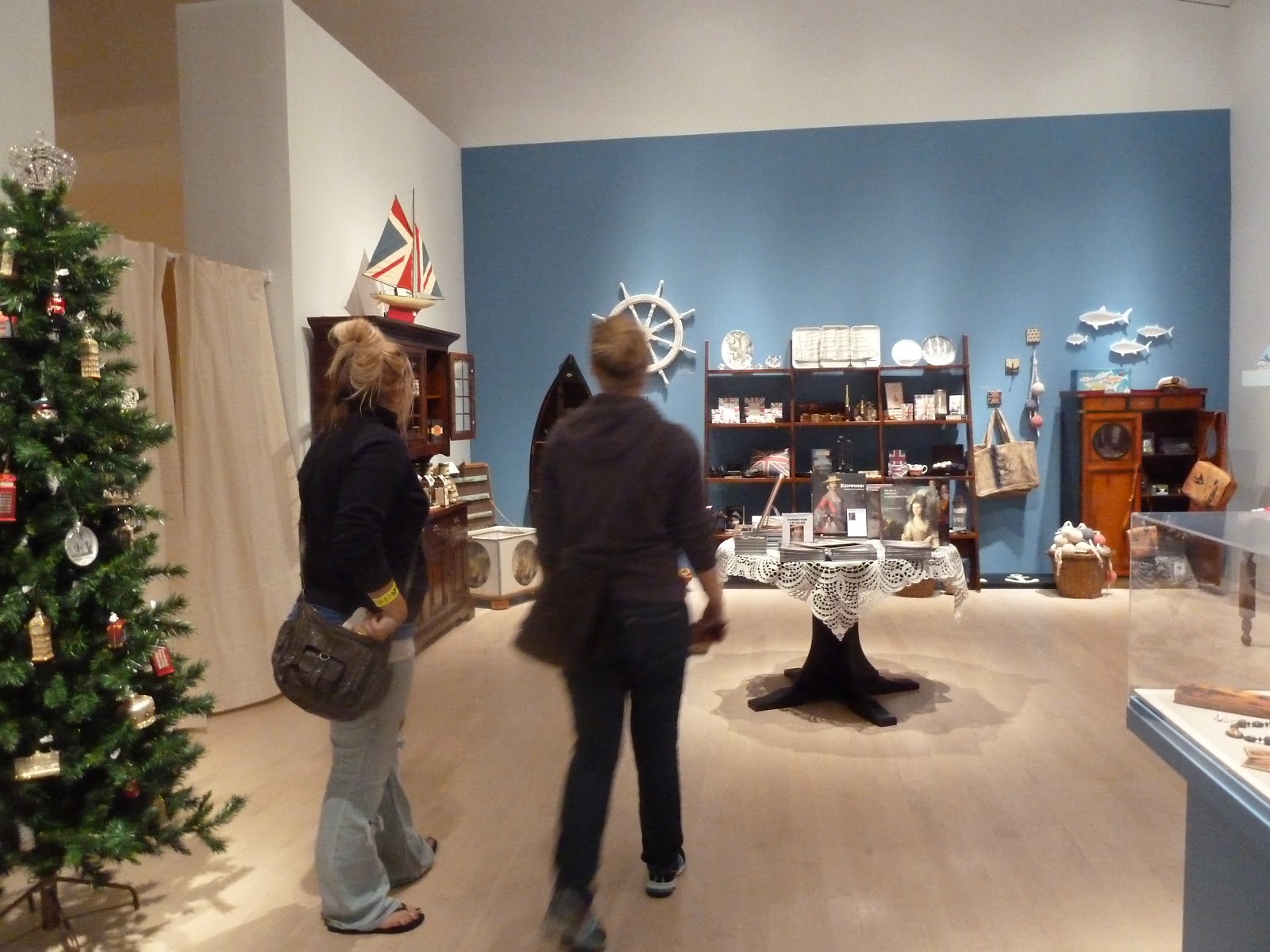
I will return to the exhibition soon and share with you more of its contents.  Until there, here are a few shots in the busy Gift Shop.

Milwaukee Art Museum Exhibition Shop
You can access the Milwaukee Art Museum Shop here.

At Auction

Canterbury Auctions in Kent will be hosting a two day sale beginning Tuesday, October 23 2012 and, once again, we just couldn’t resist perusing their catalog. Below are just a few of the fabulous items on offer:

Late 19th/early 20th Century School – Three miniature paintings on ivory – Shoulder length portraits of an aristocratic gentleman and two ladies (possibly members of the Hapsburg Royal Household), ovals 1.5ins x 1.25ins, indistinctly signed, in single gilt metal mounted mahogany rectangular three division frame, 4.75ins x 7.75ins – Guide Price: £200-300


A late 19th Century French papier-mache pull-along Bulldog with opening mouth and growling action, the head inset with glass eyes, with bristle trimmed collar for same, 21ins overall x 11.75ins high (front paws somewhat worn, various damage around chain to rear of neck, appears scuffed and marked) – Guide Price: £500-700

A George IV gilt brass Colza oil lamp of two-handled urn shape with plain arm, on stepped triangular weighted base, by Smethurst of 138 New Bond Street, 15.75ins high (converted to electricity)

Guide Price: £120-160


Colin Colahan (1897-1987) – Bronze bust – “Freya Stark” (1893-1993), 19.75ins high, signed, with attached lead seal Note : Dame Freya Stark was a well known British Explorer and Travel Writer. Writing more than two dozen books about her travels in the Middle and near East, she was one of the first non-Arabs to travel through the Southern Arabian Deserts – Guide Price: £500-700

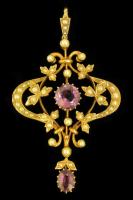
A late Victorian 15ct gold mounted seed pearl and amethyst set pendant, the central amethyst within seed pearl set scrolling leaf pattern borders with oval amethyst suspended below, 60mm x 40mm overall (grammes 6.5 grammes), contained in original brown leather covered case retailed by Wales & McCulloch Ltd, 59 Cheapside and 20 Ludgate Hill, London) – Guide Price: £250-300