NEW EXHIBIT AT THE METROPOLITAN MUSEUM OF ART

Death Becomes Her: 
A Century of Mourning Attire

October 21, 2014-February 1, 2015

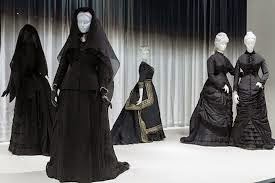
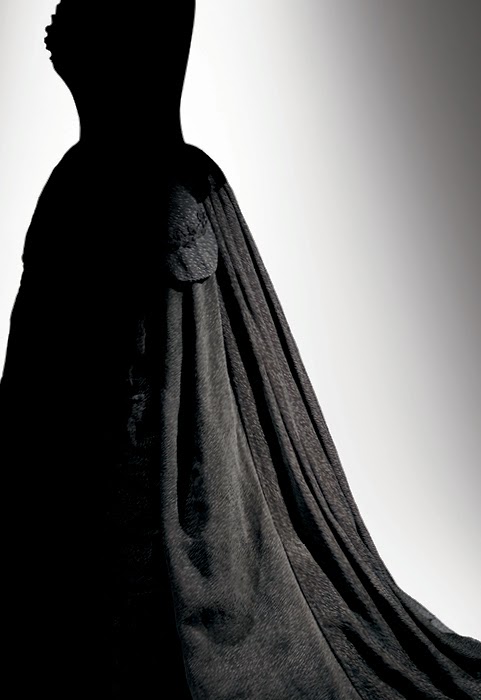
The Costume Institute’s first fall exhibition in seven years, is on view in The Metropolitan Museum of Art’s Anna Wintour Costume Center from October 21, 2014, through February 1, 2015. The exhibition explores the aesthetic development and cultural implications of mourning fashions of the 19th and early 20th centuries. Approximately 30 ensembles, many of which are being exhibited for the first time, reveal the impact of high-fashion standards on the sartorial dictates of bereavement rituals as they evolved over a century.

With the reopening of The Costume Institute space in May as the Anna Wintour Costume Center, the department returns to mounting two special exhibitions a year, once again including a fall show, in addition to the major spring exhibition. This is the first fall exhibition The Costume Institute has organized since blog.mode: addressing fashion in 2007.

“The predominantly black palette of mourning dramatizes the evolution of period silhouettes and the increasing absorption of fashion ideals into this most codified of etiquettes,” said Harold Koda, Curator in Charge of The Costume Institute, who is curating the exhibition with Jessica Regan, Assistant Curator. “The veiled widow could elicit sympathy as well as predatory male advances. As a woman of sexual experience without marital constraints, she was often imagined as a potential threat to the social order.”

Exhibition Overview
The thematic exhibition is organized chronologically and features mourning dress from 1815 to 1915, primarily from The Costume Institute’s collection. The calendar of bereavement’s evolution and cultural implications are illuminated through women’s clothing and accessories, showing the progression of appropriate fabrics from mourning crape to corded silks, and the later introduction of color with shades of gray and mauve.

“Elaborate standards of mourning set by royalty spread across class lines via fashion magazines,” said Ms. Regan, “and the prescribed clothing was readily available for purchase through mourning ‘warehouses’ that proliferated in European and American cities by mid-century.”

The Anna Wintour Costume Center’s Carl and Iris Barrel Apfel Gallery orients visitors to the exhibition with fashion plates, jewelry, and accessories. The main Lizzie and Jonathan Tisch Gallery illustrates the evolution of mourning wear through high fashion silhouettes and includes mourning gowns worn by Queen Victoria and Queen Alexandra. Examples of restrained simplicity are shown alongside those with ostentatious ornamentation. The predominantly black clothes are set off within a stark white space amplified with historic photographs and daguerreotypes.

Related Programs
In conjunction with the exhibition, a Halloween event on October 31, 6:30–8:30 p.m., will encourage visitors to chart their own path through the galleries and join drop-in,
interactive experiences with art.  Ms. Regan will give a Friday Focus lecture, Women in Black: Fashioning Mourning in the 19th Century, on Friday, November 21, at 4:00 p.m. Musical programming includes a special pop-up concert featuring Icelandic cellist Hildur Guðnadóttir on October 17 at 6:00 p.m., and a performance by vocalist Theo Bleckmann on February 7 at 7:00 p.m.

The Museum’s website, www.metmuseum.org/deathbecomesher, features information on the exhibition and related programs.
Click here for a review of the Death Becomes Her by Elle Magazine

Harper’s Bazaar reviews the show here and includes a 
slideshow of the best mourning costumes in film.

LOOSE IN LONDON: KRISTINE'S FIRST DAY – PART ONE

I arrived at our hotel early from the airport – before 9 a.m., and so our room wasn’t ready. In fact, I was told that it wouldn’t be ready till closer to 2 p.m. I left Big Red and my carry-on bags with the hotel and crossed Sloane Square to Duke of York Square, which was deserted save for one or two coffee places that were already open – not, alas, a Café Nero in sight. So I bought a coffee and sauntered around the Square as well as a limping person with sore feet can saunter. Being that I was unable to affect a careless Bertie Wooster type of saunter, I had no choice but to settle for more of a Boris Karloff as the Mummy sort of gait.  I would have been happy to walk the entire length of the King’s Road and back again in order to kill time, as there’s nothing I love more than strolling the streets of London, whether I have a firm destination or no. However, my feet weren’t going to cooperate so I sat for a while on a bench and watched the passing parade of people. Note to self and you: almost every woman who walked past me, regardless of age or profession, was wearing ballet flats and a short, black leather jacket. Ergo, buy short, black leather jacket as it will no doubt be the next big thing this season.
Whenever I travel to Englandwith my daughter, Brooke, we spend the first few hours after our arrival marveling at the fact that we’re in England. “Look!” we’ll cry, “an English dog!” “Look, an English postbox!” “Look, an English Starbucks!” “Look, a black cab!”  I soon found this exercise was much less fun when played by oneself and so gave it up fairly quickly. Finishing my coffee, I summoned my determination, defied the pain and began the walk from King’s Road down to the Royal Chelsea Hospital. Despite knowing well its Wellington connections, I’d never visited before and so had planned to rectify this gap on this day, prior to Victoria’s arrival. No time like the present.
I slow walked my way down to Royal Hospital Road, in reality just a quick jaunt away from the Square, but the state of my feet made the walk that much longer. And more painful. By this time, my feet had blisters on both little toes, there was a raw spot across the top of one foot where a strap had rubbed and my feet had apparently swelled during the flight, making my comfortable sandals feel two sizes too small. At long last I arrived at the gates of the Hospital, only to be told that the Museum wouldn’t open for another hour. Sob.
The walk back to Sloane Square was horrendous, but I finally made it back up to the King’s Road, where I spotted an open Boot’s Pharmacy. Inside, I made my way to the bandage section, selected some cushioned band-aids and then walked back to the hotel. I asked for Big Red to be brought out and divested myself of sandals before papering my poor feet with bandages. Then, I put on a pair of ballet flats and gingerly took a few steps in order to test them out. No pain, so I was good to go.
Back to the Royal Chelsea HospitalI went, which was by this time open. Going through the gates, I spotted a small graveyard off to the left and decided to stroll through the headstones, finding many Regency era dates. Some of the stones marked military graves, whilst others remembered those who had administered to the running of the Hospital through the centuries, along with their family members.

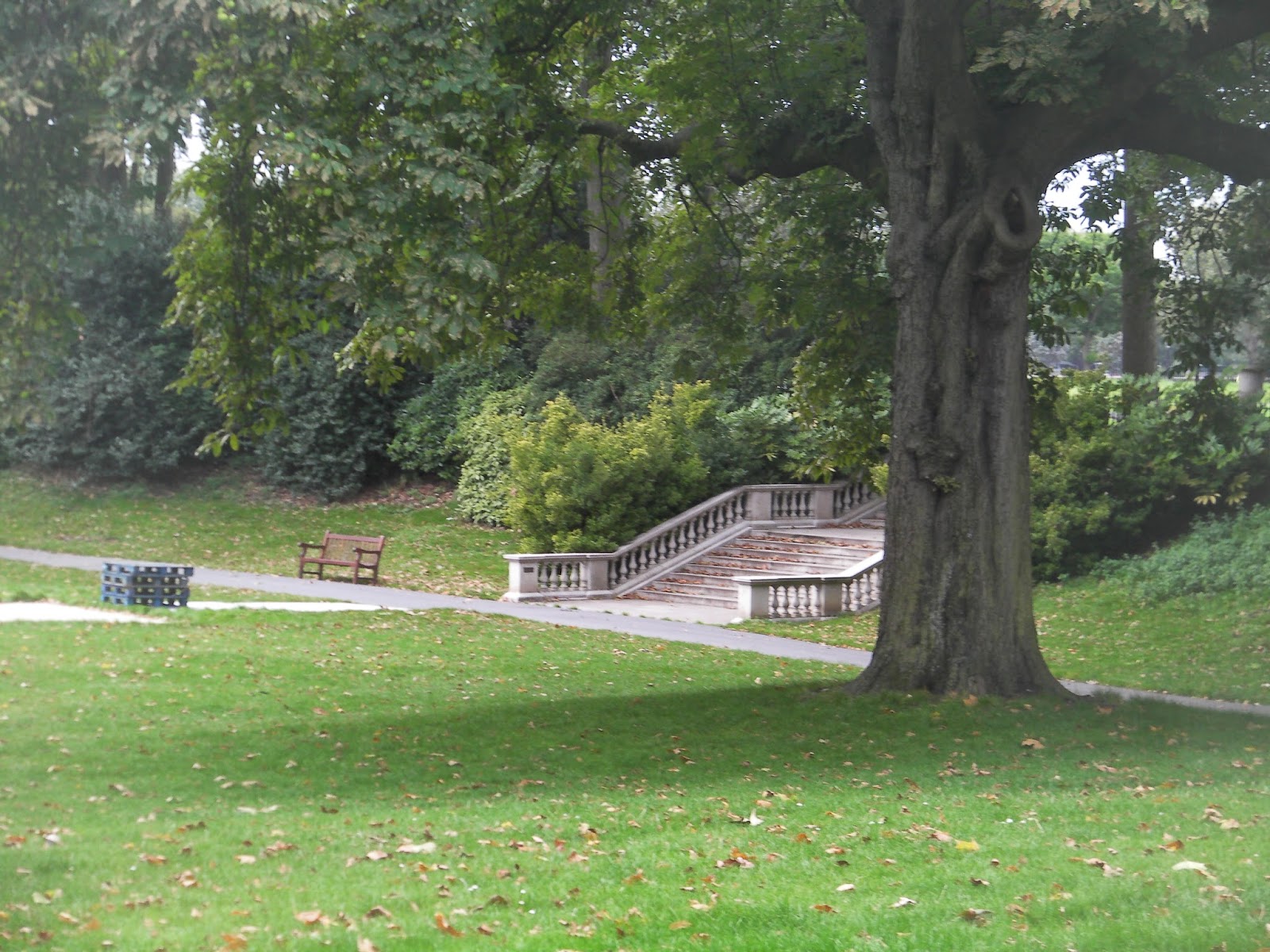
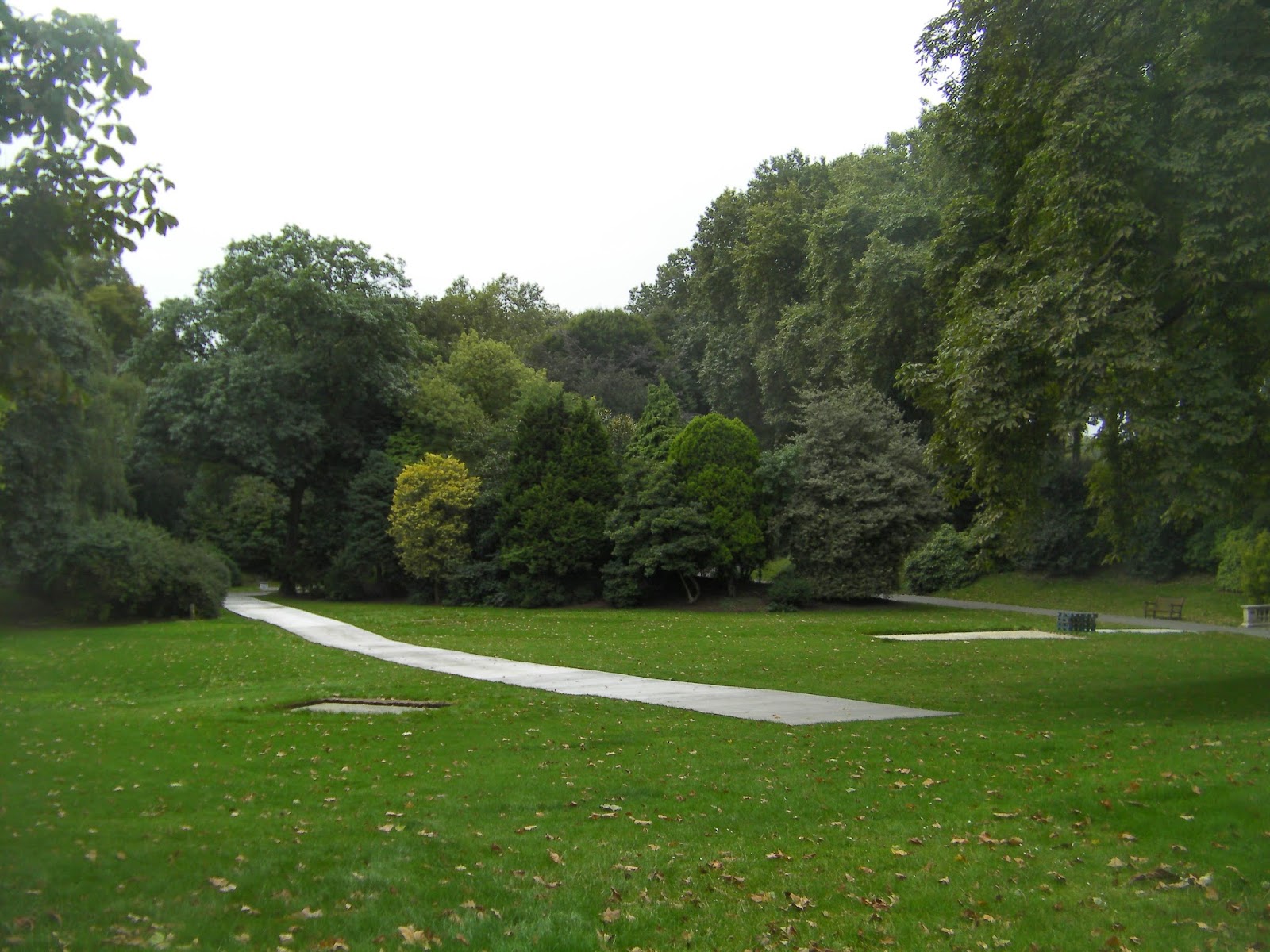
Afterwards, I was headed towards the Museum when I spotted a sign that read “Ranelagh Gardens.” If you’re a regular reader of this blog, you’ll know that one of the things I’d been longing to do was to visit the site of the old Gardens, so of course I made a bee line in the direction indicated on the sign. Along the way, I passed the allotments where the current Chelsea Pensioners grow absolutely stunning flowers. Everything appeared to be blooming and the variety of flowers was amazing. I passed a few people along the way, nodded to Pensioners and a handful of young mothers who were pushing prams along the paths, but otherwise I was alone. Finally, the path brought me to the boundary of Ranelagh Gardens, where I strolled in historic contemplation for a few minutes before telling myself, “Look, you’re in Ranelagh Gardens!” Sigh.  
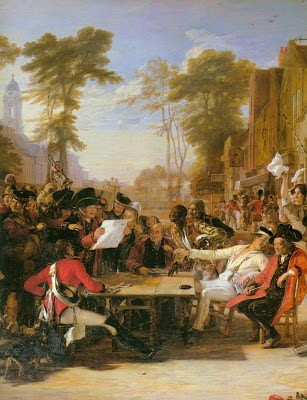
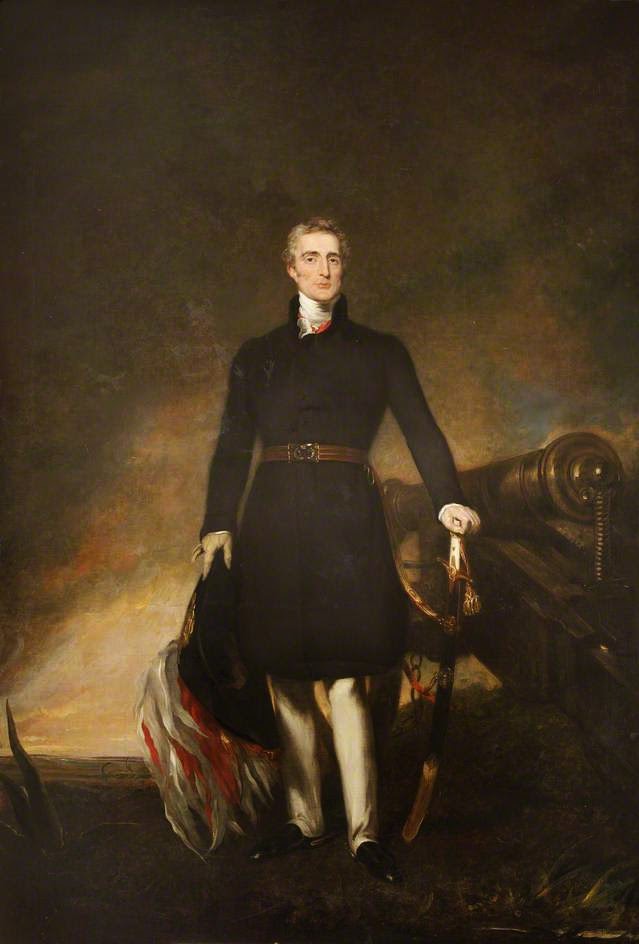
And then I did make my way to the Museum, where I was met with several oversized paintings of the Duke of Wellington. Welcome, indeed! No Chelsea Pensioners Reading the Waterloo Despatch to be seen, however. They must have it hanging in the Museum, I thought, but failed to find it as I made my through the exhibits.
In the gift shop, I bought a Christmas ornament to add to my collection and then I asked how to find the Great Hall, where Wellington’s body had lay in state. Surely the painting of the Chelsea Pensioners had to be there. Following the directions I’d been given, I was making my way over to the Great Hall when I began to feel great discomfort at the top of each heel. You know, where your Achilles tendon is? I sat on a bench and took off one ballet flat – the back of the shoes were rubbing at the top of each heel and taking some skin off with each step. Believe me, I packed these flats because they’ve always been extremely comfortable. As were the sandals I’d worn on the way over. Until this particular trip.
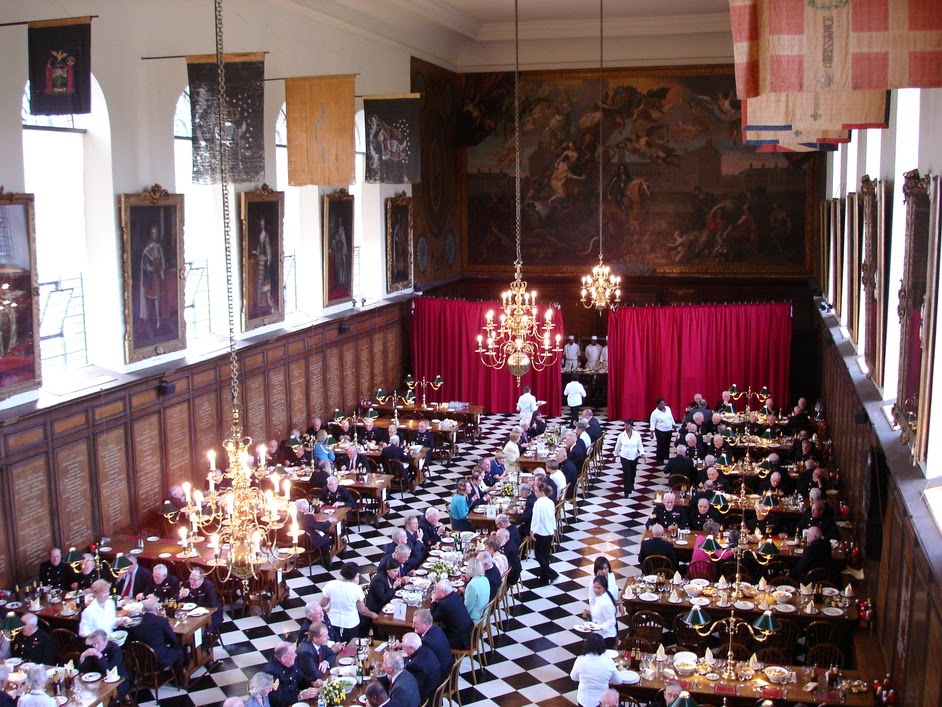

I finally found the Great Hall, only to discover that it was being used as a dining hall, set up with rows of long tables and chairs. It seemed much smaller than I’d imagined and try as I might, I couldn’t summon up the atmosphere that must have existed when thousands of people had streamed through to pay their final respects to the Duke of Wellington. 
So back I limped to the gift shop, where I asked the nice old soldier behind the counter, “Do you know where The Chelsea Pensioner’s Reading the Waterloo Despatch is?”
“Pardon?”
“The painting, The Chelsea Pensioner’s Reading the Waterloo Despatch?”
“Pardon?”
“It’s a painting that was commissioned by the Duke of Wellington. Of ChelseaPensioners. Reading the Despatch. From Waterloo. About the victory? At Waterloo?”
“Never heard of it. Hey, Bert, have you ever heard of a painting called the Pensioners Reading . . . . what was it they were reading?”
“The Waterloo Despatch,” I told him.
“The Waterloo Despatch,” he told Bert.
“No,” said Bert, “Never heard of it. Maybe it’s in the Museum.”
“No, I’ve looked in the Museum and in the Great Hall,” I told them.
“Maybe it’s hanging in that little hallway out back,” Bert suggested.
“I’d think it would be hanging in the lobby,” I said, “Along with the other Wellingtonportraits. It would be closer to that size. It’s not a small thing.”
“Nope, don’t know anything about it,” said the first Pensioner. “I’ll take you along to the Administrator’s office. Mebbe they know where it’s at.” I followed him through a warren of hallways until we arrived at the Administrator’s Office.
“This lady’s looking fer a painting by the Duke of Wellington.”
I popped my head around the Pensioner and saw an assistant sitting behind her desk. “It was commissioned by the Duke of Wellington. The Chelsea Pensioner’s Reading the Waterloo Despatch?”
“I’m sorry?”
“It’s a painting depicting the red coated Pensioners sitting round a table reading the news of the victory at the Battle of Waterloo.”
“I’m not familiar with it, but all of our Wellington portraits are in the entrance hall. Have you looked there?”
“I have. It’s not there.”
“Well, I’ll tell you what, I’ll ask our curator when he comes in this week and I’ll try to find out where it is. Can you come back next week? Hopefully I’ll have an answer for you then.”
Well, there was nothing for it. I thanked her, and the Pensioner, and said I’d check back in a few weeks time, when I was due to return to London. Then I began the painful  trek back to Sloane Square, for the second time. Whilst wearing a second pair of painful shoes that made every step I took sheer torture. Sigh.
Returning at last, again, in the hotel lobby, I again asked for Big Red to be brought out of the luggage holding area. I again applied bandages to my feet, this time to the backs of my heels and then I pulled on a pair of socks followed by a pair of flat boots with the fur trim. Yeah, I was aware that the temperatures were in the 70’s, but I was getting desperate. I was quickly running out of shoe options and my day was flying by. I still wanted to make my way over to Piccadilly and Apsley House. Footwear be damned – I headed out again, this time making my way to the tube station.
Part Two Coming Soon!

TRAVELS WITH VICTORIA: THE BAYEUX TAPESTRY

On my recent trip to France, I fulfilled a lifelong desire to see the Bayeux Tapestry, that iconic portrayal of the Norman version of William I’s invasion and conquest of Britain in 1066.

Home of the Bayeux Tapestry
 
We were on a Viking River cruise on the Seine, starting and finishing in Paris.  One day was devoted to a bus trip from the river to the D-Day Normandy Landing Beaches.  On the way, we stopped in the charming town of Bayeux to see the tapestry.
 
An old mill, on the path from the car park to the museum
 
The tapestry is really woolen embroidery on linen, not a woven piece.  Just who made it and when is a mystery, though the tale it tells — the Norman side of the story — indicates it was created by the women of the Norman court in England a few years after the Conquest. The controversy about its origins and the validity of its version of the Conquest remain contentious even today.
   
Odo, Bishop of Bayeux, in the Battle of Hastings
(pic from Wikipedia)
 
To see the entire tapestry, click here


Two-hundred thirty feet in length, the Bayeux Tapestry was created to be shown in cathedrals and large churches to tell the story and justify the Norman Conquest.  In fifty scenes, the story of King Edward’s (the Confessor, c.1003-1066) succession, the relationship of Harold, King of Wessex, and William Duke of Normandy. According to this version of the story, Harold is sent by the ailing Edward to France in order to deliver news of the King’s choice of successor to William, who will become King of England upon Edward’s death. 
 
Edward gives Harold a message for William
 
Even the guides at the museum in Bayeux agree this version is “propaganda” from the Norman side of the historical record. The actual wishes of Edward the Confessor might have been less important than the vote of the Witenagamot, an assembly of powerful nobles.  The Witenagamot actually voted for Harold after the Confessor’s death. But it is not necessary to view the Tapestry as the REAL story to admire it for its beauty and historical significance.
 
Harold’s Coronation as King of England
 
The tapestry was listed in the inventory of the Bayeux Cathedral in 1476; it was shown every year on the Feast of St. John the Baptist for centuries. Since being displayed in the Louvre, Paris, in 1797, it has been regarded as a national treasure.
 
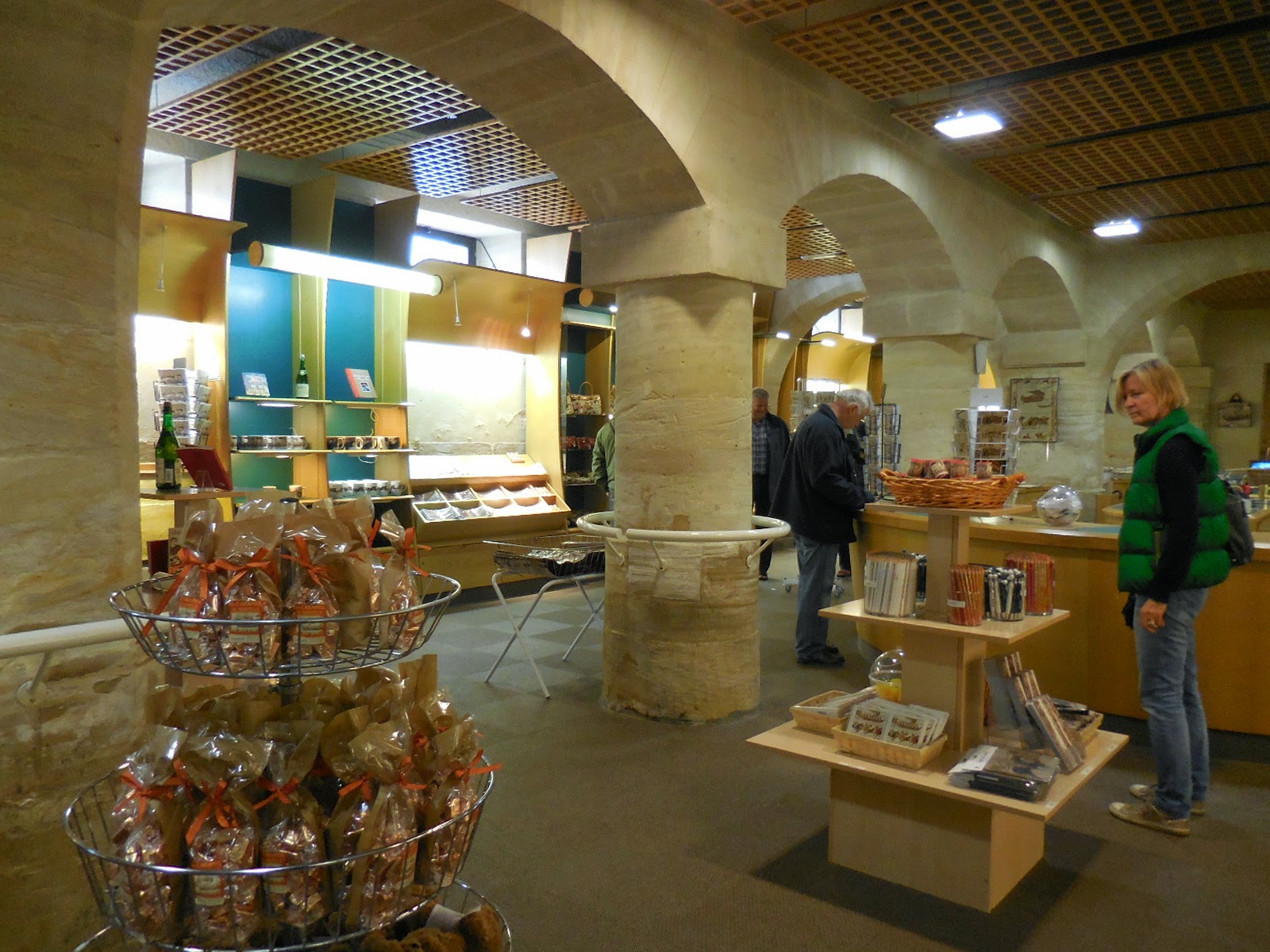
scenes reproduced and for sale in the museum gift shop
 
Numerous replicas exist and the scenes from the narrative had been studied as excellent sources of information about life in the 11th Century.  The particular excellence of the stitching is praised and the colors are today quite brilliant for such an old creation.
 
stitching details
 
In horizontal sections at the top and bottom of the tapestry, scenes of everyday life are portrayed, events of the day told, and animals depicted.
 
a comet
 
The Bayeux Tapestry has survived many wars and  planned confiscation by Napoleon and the Nazis, among others. One hand-stitched replica was used in the filming of the recent movie The Monuments Men (2014).  The original is now shown beautifully in its own Musée de la Tapisserie de Bayeux.
 
Museum Giftshop
 
A few years ago, I visited the site of the Battle of Hastings in Sussex where an audio tour leads one around the grounds, told in the voices of the women who were attached to the two leaders, Harold and William.
 
Site of the Battle of Hastings, 1066
 
Here, on the site of the death of Harold, William erected an Abbey, now partly in ruins and partly  school.
 
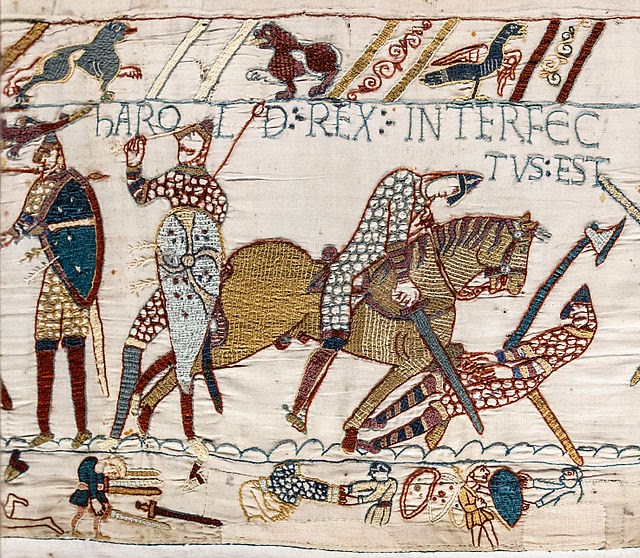
Death of Harold, Bayeux Tapestry
 
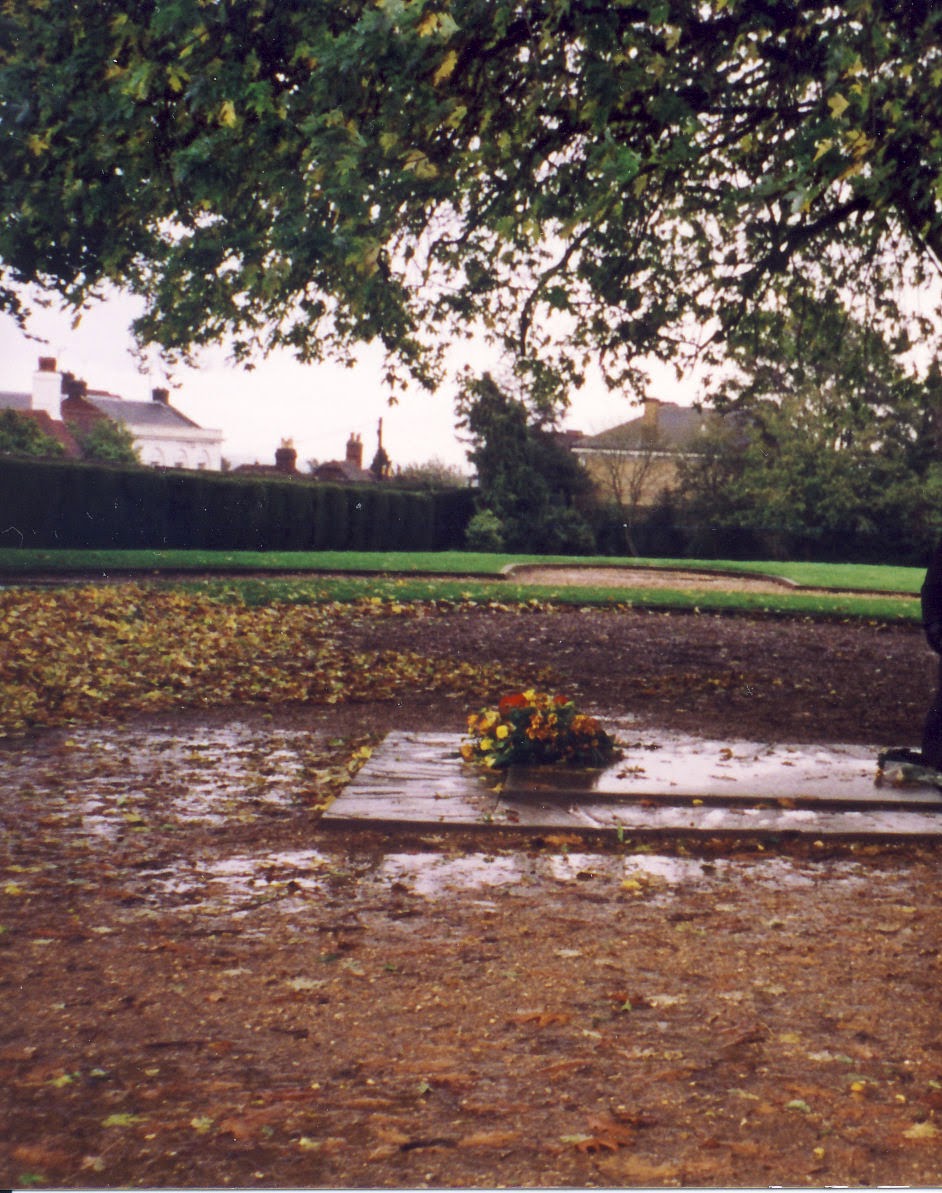
Site of the High Altar, said to be where Harold fell
 
As we walked around the ruins on that October day, we noticed flowers on the site of the High Altar.  We when looked closely, we got chills!  Here was a tribute, almost thousand years later.
 
It reads: “King Harold: Unconquerable Except by Death, 14 Oct, 1066” 
 
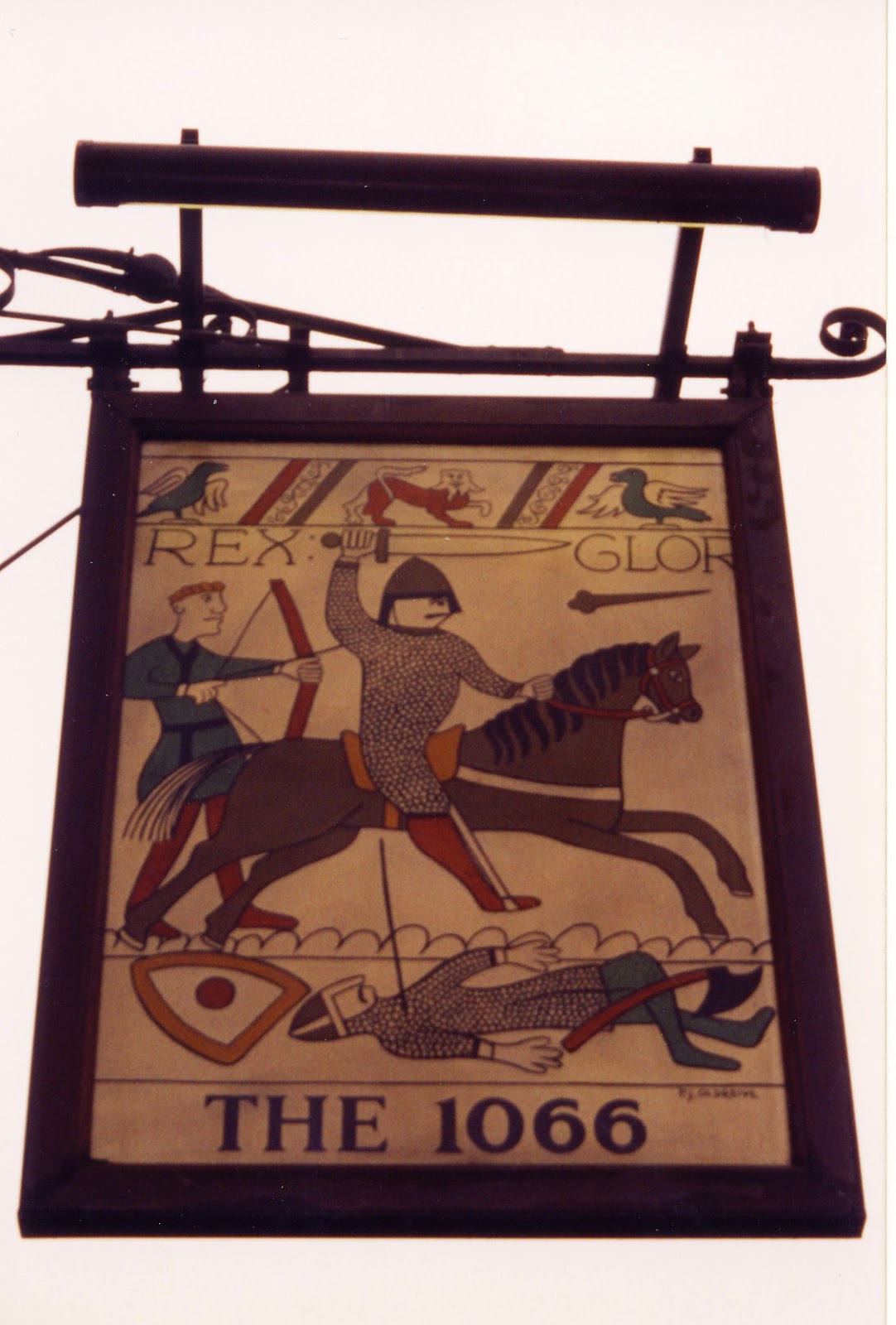
Pub Sign in Battle, Sussex
 
Of course, the pub owner could not resist!!  We settled in, actually for a pot of tea, after our encounter with the Abbey, the battle and the flowers left by admirer from centuries after the fighting.  Battle, the spot where the conflict took place and the town named so cleverly, is a few miles inland from Hastings, where the Norman fleet landed on the coast.
 
Bayeux Cathedral
 
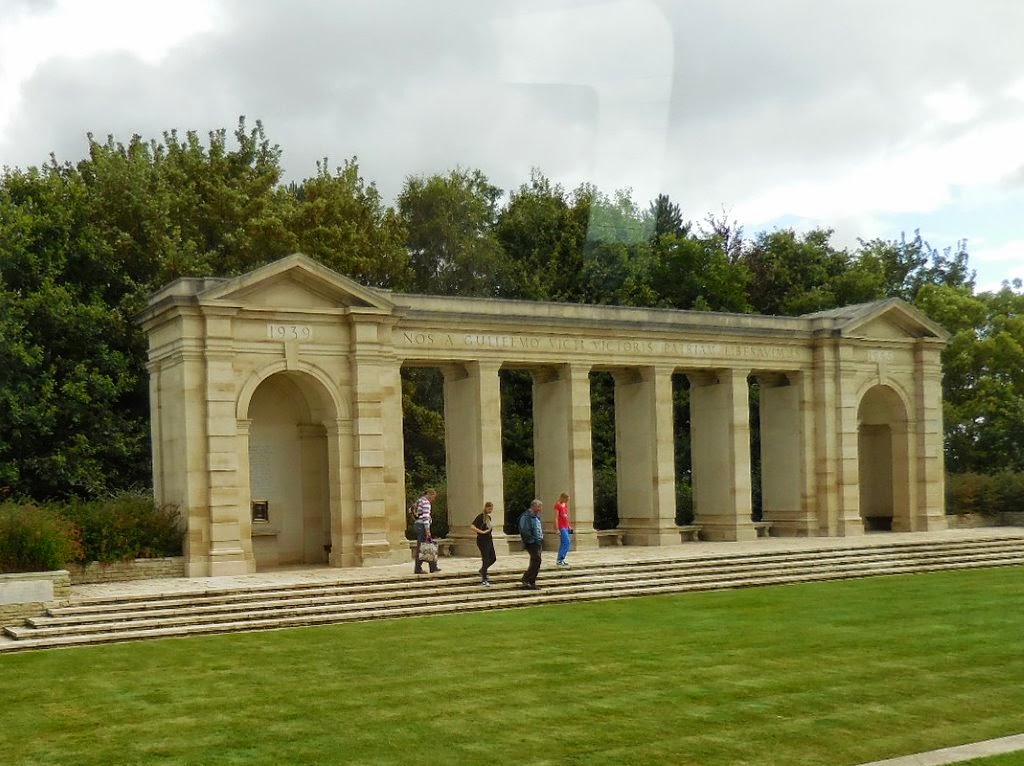
Returning to my trip of 2014, we left the Tapestry to go to the Bayeux Commonwealth War Graves Commission Cemetery, where more than 4,600 are buried.  A marble memorial stands at the entrance.
 
The Inscription reads (in Latin) “We, once conquered by William,
have now set free the Conqueror’s native land.”
 
Chills once more!!
 
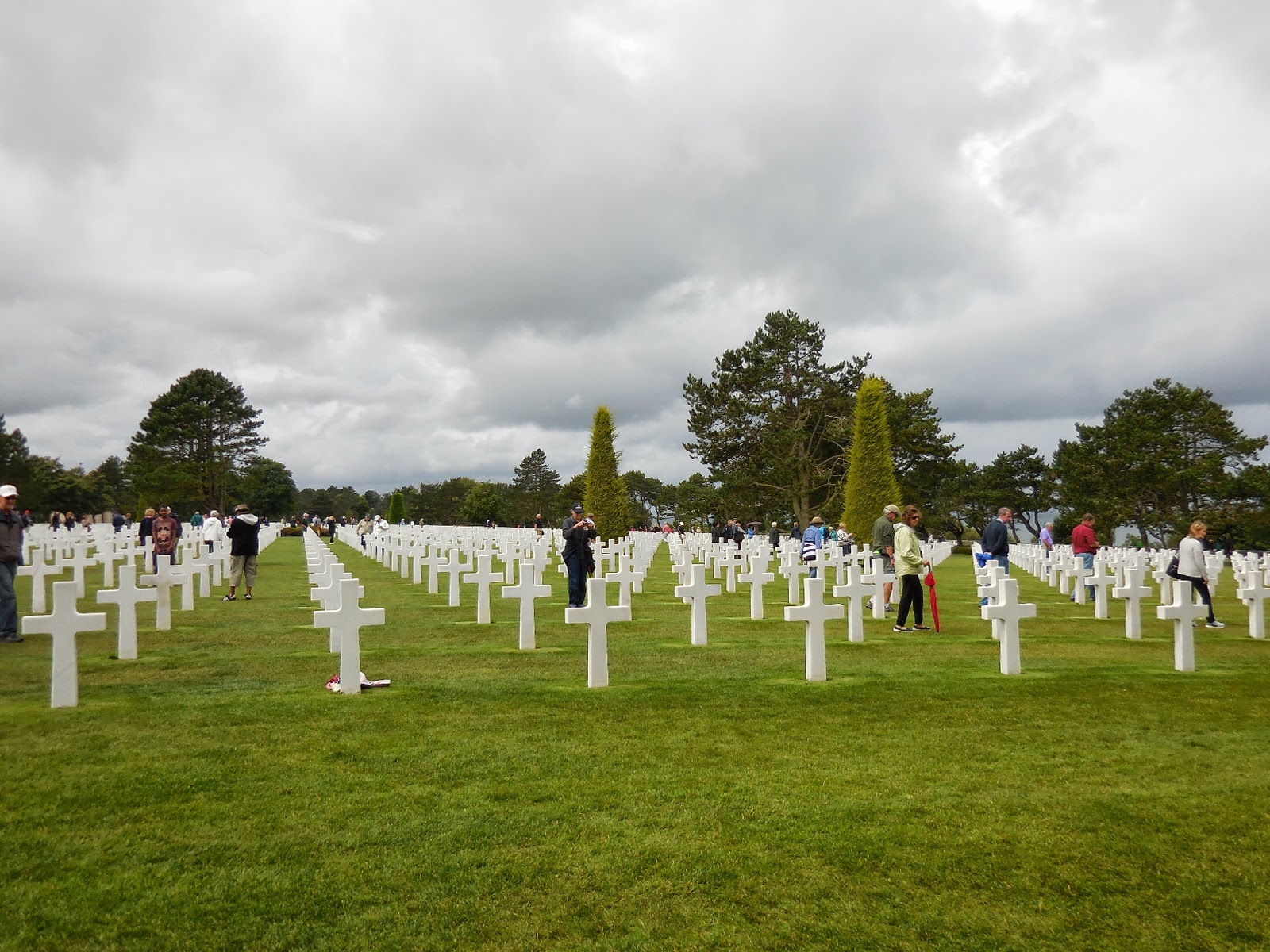
To conclude the day, we toured the Normandy American Cemetery and Omaha Beach, accompanied by many more chills of appreciation.
 
The Memorial at the American Cemetery
Among the 9,400 graves

Omaha Beach
 
 
Les Braves, memorial sculpture by Anilore Banon
in honor of the 60th anniversary of D-Day, 2004


VIDEO WEDNESDAY: TOUR OF THE OLD CORONATION STREET SET

As some of you may recall, when Victoria and I were first planning the Duke of Wellington Tour, I was anxious to schedule a side trip to the old Granada Studios in Manchester to see the set of Coronation Street. The entire production has since moved to a new set at a larger facility, where every house, every cobble and every shop has been faithfully recreated. The old set is now open for daily tours and I so wanted to get there in order to see it all before it was dismantled. Unfortunately, a side trip to the north of England was not in the cards this trip over. However, I did find an amateur video that a fan (stunninglad1) kindly recorded during their trip to the cobbles and you can watch it here. The video includes an overview of the street, a look at the individual houses, all the shops, Rosamund Street, the bus stop and even the ginnel! Night falls towards the end of the half hour video and you can see the lights come on as night falls over this beloved section of Weatherfield. A true trip down memory lane that we hope you’ll enjoy. 


LOOSE IN LONDON: KRISTINE LEAVES FOR HEATHROW – PART THREE

I turned away from the United desk and began the journey up the escalator to the security checkpoint whilst carrying the incredibly heavy black bag, with the incredibly heavy purse now slung like a cross-body around my torso. My little toes screamed with every step and I silently screamed back.

“Just a bit longer,” I told myself, “and you’ll be in England for nearly a month. A month. You can do this!” Of course, there were many more passengers waiting to go through security than there were security check points to deal with them efficiently. The line crawled along and I inched my way towards the scanners one painful step at a time. Who knew that my most comfortable sandals would turn into devices of torture simply because I’d been forced to carry an extra forty pounds or so?

Finally, I made it through security and retrieved my belongings from the conveyor belt before I scanned the signs overhead to see where my gate was. The sign read “Gates 1 to 2,034 to the Right.”
I wanted to cry. My gate was literally the last one. The absolute furthest from where I now stood.

I longed to remove my shoes, but thought better of that – no telling what was embedded in the floors after millions of passengers had trod on them. I thought about having a drink, but didn’t see any bars. Finally, I thought about the men who had comprised Wellington’s armies and how far they’d been asked to walk on a daily basis. Surely 19th century boots had to have been more uncomfortable than my sandals after walking miles in them whilst carrying heavy packs on their backs, along with weapons and ammunition. And canteens. All whilst wearing red woolen coats. In the heat of the Peninsula. Or in India. At least at the end of my journey I’d be at the plane that would be flying me to England. A much better destination than a battle at Waterloo, surely.

“Just a bit longer,” I told myself, “and you’ll be in England for nearly a month. A month. You can do this!”

The longer I walked, the more painful each step became. Before long, I was limping along like an old lady. A really old lady. And I still hadn’t passed a single bar. Finally, I spotted a maintenance worker by a trash can and asked him, “Where’s the nearest place I can get a drink?”

“Huh?”

“A drink. Liquor. A cocktail. You know, a bar?”

“Oh, right. Well, there’s an Irish pub down that way, right across the way from Gate 2,034.”

Thinking that there may just be a God after all, I slowly completed the last painful mile that separated me from the nearest bottle of Bacardi.

Arriving at last at Mecca, I sat down at the bar and ordered a double rum and coke and a tall glass of water, which I finished half of in a few gulps as soon as it arrived. The water, not the rum and coke. Then I called Hubby to let him know I’d arrived in Newark and allowed him a couple of I told you so’s in regards to my present problem regarding overweight luggage. When we’d hung up, I spotted a redhead climbing onto the stool beside mine. The bartender came over and she ordered herself a white wine. We both sat sipping at our drinks for a few minutes before she asked me if I were going to Dusseldorf.

“No. London,” I said curtly, not being in the mood for casual chit chat. I picked up my glass of water and finished it off in another few gulps.

“You shouldn’t drink water, you know. It’ll poison you. Our kidneys can’t process all the poisons in water. My kidneys haven’t worked for fourteen years.”

Oh, great. A health nut.

“I only drink wine. White wine. The red stuff has too many chemicals in it. It’ll kill you.”

Sigh.

“I always drink wine, whether I’m at home or traveling. I’m going to Dusseldorf for the weekend,”

Against my better judgement, I said, “You’re flying all the way to Dusseldorf just for the weekend?”

“Yeah. I fly to Europe for the weekend once or twice a month. I’ve been everywhere. I’ve been doing it for years.”

“How do you manage that, I mean with the dialysis and that.”

“What dialysis?”

“You said that your kidneys hadn’t worked in fourteen years,”

“Oh, that. No, I’m not dialysis. I still have my kidneys, they just don’t work. They haven’t worked since I fell into a canal in Venice.”

I finished off my rum and coke and ordered another.

“See, the water in the canals is filthy, just filthy. And when I fell in, I was attacked by this type of parasite that lives in the water there. The parasites invaded my body and attacked my organs and my kidneys and they shut down and haven’t worked right since. Water will kill you, believe me.”

Oh, great. Not a health nut. Just your average, garden variety nutter. No way was I going to ask her how she’d managed to fall into a canal in the first place.

“I believe you. That’s why I only drink rum,” I said instead as I slid my credit card across the bar towards the bartender. While I was waiting for my receipt, I fished around in my purse for my sleeping pills, shook a couple out into my hand and downed them with a swallow of rum and coke. I had an hour until my flight boarded and, with any luck, I’d be nice and drowsy by the time we lifted off.

Limping my way across to my departure gate I told myself, “Just a bit longer and you’ll be in England for nearly a month. A month. You can do this!”